THE RIVER OF PARADISE AND ITS FOUR STREAMS
The river flowing from Eden to water the garden, which then divides into four heads, carries profound theological significance that extends far beyond mere geography. The Church Fathers consistently interpreted this passage typologically, seeing in these waters a prefiguration of the life-giving grace that would flow from Christ to the whole world.
Patristic Interpretation: Saint Ambrose of Milan understood the river of Paradise as a type of Christ Himself, from whom flow the four Gospels that water the entire earth with the knowledge of God. Just as the single river divided into four streams to reach the four corners of the ancient world, so the one Gospel of salvation is proclaimed through four evangelists to all nations. Saint Ephrem the Syrian similarly taught that these four rivers represent the fourfold proclamation of the Good News, bringing spiritual refreshment to humanity parched by sin.
Saint John Chrysostom noted that while the literal rivers may be difficult to identify with certainty in the present age, the spiritual reality they signify remains eternally true. The waters that proceed from the presence of God bring life wherever they flow, anticipating the river of the water of life described in Revelation 22, which proceeds from the throne of God and of the Lamb.
Christological Significance: Our Lord Himself spoke of living water flowing from within those who believe in Him (John 7:38-39), connecting the imagery of Paradise to the gift of the Holy Spirit. The original river of Eden thus finds its fulfillment in Christ, the true source of living water. At Jacob’s well, Christ revealed Himself as the one who gives water springing up to eternal life, restoring what was lost when humanity was exiled from the garden.
Liturgical and Baptismal Connections: The Orthodox Church sees in these Edenic waters a prefiguration of holy Baptism. In the blessing of baptismal waters, the Church prays that the waters might become a fountain of incorruption, recalling the original blessing of the waters of Paradise. The faithful, through Baptism, are restored to the garden from which Adam was expelled, now watered by the grace flowing from Christ’s wounded side.
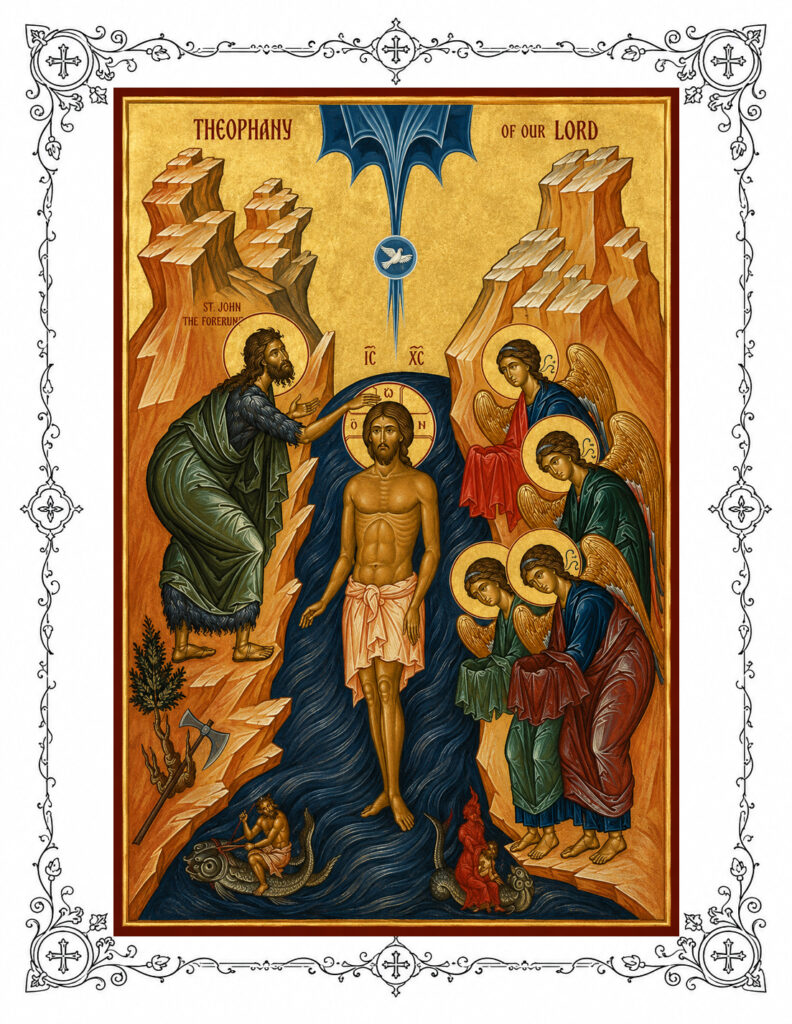
The Theophany blessing of waters similarly draws upon this imagery, as the Church sanctifies the waters of creation, returning them to their original blessed state. The four directions to which blessed water is sprinkled recall the four rivers reaching to the ends of the earth.
Spiritual Application: For the Orthodox Christian, this verse reminds us that all authentic spiritual life flows from a single divine source. We cannot manufacture grace but must receive it from God, who alone is the fountain of immortality. The multiplication of the one river into four streams also teaches that divine grace, while singular in origin, adapts itself to reach all peoples in their particular circumstances.