Genesis 3:12
The Blame and the Fracturing of Communion
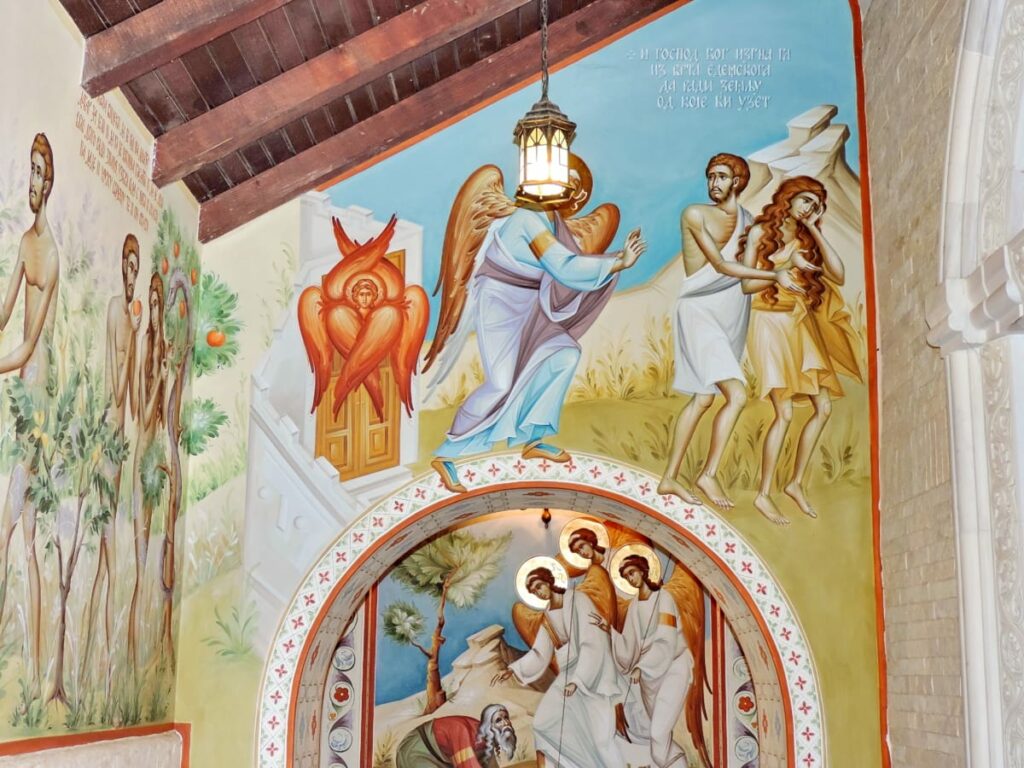
In this verse, Adam responds to God’s inquiry not with repentance but with deflection, pointing simultaneously to Eve and, remarkably, to God Himself: “The woman whom You gave to be with me, she gave me of the tree, and I ate.” This response reveals the immediate spiritual consequences of the fall—the rupture of communion on multiple levels.
The Fathers consistently note that Adam’s words represent a failure of authentic confession. Saint John Chrysostom observes that had Adam simply acknowledged his transgression and sought mercy, the severity of the consequences might have been mitigated. Instead, Adam compounds his sin by refusing accountability and subtly implicating the Creator in his own disobedience. Chrysostom writes that Adam essentially says, “The fault is Yours for giving me this woman.” This represents not merely evasion but a kind of theological accusation against divine providence.
Typological Significance for Christology
The contrast between Adam and Christ becomes luminous here. Where the first Adam deflects blame onto the woman given to him, the Second Adam—Christ—takes upon Himself the sins of His Bride, the Church. Saint Irenaeus develops this Adam-Christ typology extensively, showing how Christ’s obedience unto death reverses Adam’s disobedient self-justification. Christ, though sinless, accepts responsibility for humanity’s transgression, whereas Adam, though guilty, refuses to accept responsibility for his own act.
Furthermore, where Adam distances himself from Eve in blame, Christ draws near to fallen humanity in redemptive solidarity. The Bridegroom does not accuse His Bride but cleanses her through His own blood.
Liturgical and Spiritual Dimensions
The hymnography of Forgiveness Sunday and the preparatory weeks before Great Lent frequently invoke the expulsion from Paradise and Adam’s fallen state. The Lenten Triodion presents Adam weeping before the gates of Eden, finally recognizing what his self-justification cost him. Orthodox liturgical tradition thus presents the journey of repentance as the reversal of Adam’s posture in Genesis 3:12—moving from blame to authentic confession, from accusation to supplication.
In the Mystery of Confession, the penitent is called to do precisely what Adam failed to do: acknowledge sin without excuse, without deflection onto circumstances or others. The prayer before confession explicitly warns against self-justification, recognizing it as the original pattern of fallen humanity.
Ascetical Application
The spiritual fathers identify this tendency toward blame as deeply embedded in fallen human nature. Every accusation against another, every excuse offered for our failings, echoes Adam’s words before God. Saint Dorotheos of Gaza teaches that self-justification is among the most persistent obstacles to spiritual progress, for it prevents the soul from receiving healing grace. True metanoia requires the courage Adam lacked—to stand before God in naked honesty, trusting not in excuses but in divine mercy.