GENESIS 4:1
The Knowledge of Adam and the Birth of Cain
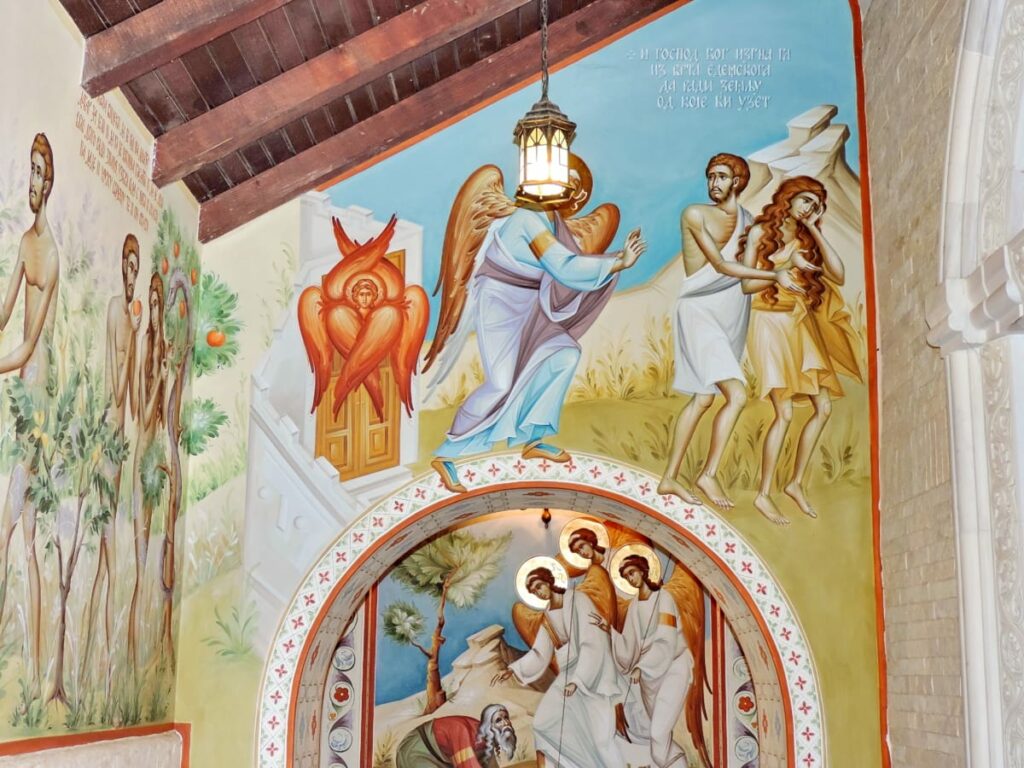
This verse presents the first instance of marital union and human procreation following the expulsion from Paradise. The Hebrew verb “yada” (to know) employed here carries profound theological significance, indicating not merely physical union but an intimate, personal knowledge between persons. The Church Fathers understood this “knowing” as reflecting the deep communion intended by God for marriage, a union of persons rather than mere bodies.
Eve’s exclamation upon Cain’s birth—”I have acquired a man from the Lord”—reveals both faith and perhaps misunderstanding. St. John Chrysostom observes that Eve recognized God as the source of life and fertility, demonstrating that even after the Fall, humanity retained awareness of divine providence. Some Fathers suggest Eve may have believed Cain to be the promised seed who would crush the serpent’s head (Genesis 3:15), a hope that would prove tragically misplaced given Cain’s future fratricide.
Christological Significance
The contrast between Cain and Christ emerges powerfully in patristic interpretation. Where Cain, the firstborn of fallen humanity, becomes a murderer, Christ, the Firstborn of all creation and the New Adam, gives His life for others. The Epistle to the Hebrews explicitly draws this contrast, stating that the blood of Christ “speaks better things than that of Abel” (Hebrews 12:24). Thus, this verse initiates a typological pattern fulfilled in the Incarnation.
Liturgical and Spiritual Themes
The Orthodox funeral service references Abel as the first among the righteous dead, establishing a connection between this narrative and the Church’s understanding of death and resurrection. The birth of Cain, followed by his sin, reminds the faithful that physical generation alone cannot restore humanity—only the new birth through baptism into Christ accomplishes true renewal.
St. Ephrem the Syrian meditates on Eve’s words, noting that she acknowledged the Lord as the giver of children, teaching the Church that all human life proceeds from divine blessing. This understanding permeates the Orthodox marriage service, which invokes God’s blessing upon the couple for the gift of children.
The verse also introduces the theme of human labor and acquisition (“I have acquired”), connecting to the curse of toil pronounced in Genesis 3. Yet Eve’s thanksgiving transforms this acquisition into an occasion for glorifying God, modeling the Orthodox spiritual practice of offering all things back to the Creator with gratitude, even amid the consequences of the Fall.