Introduction to the book of Leviticus
The Book of Leviticus receives its English title from the Latin Vulgate, which is derived from the Greek Septuagint (LXX) title Leuitikon (Λευιτικόν), meaning “Levitical” or “pertaining to the Levites.”
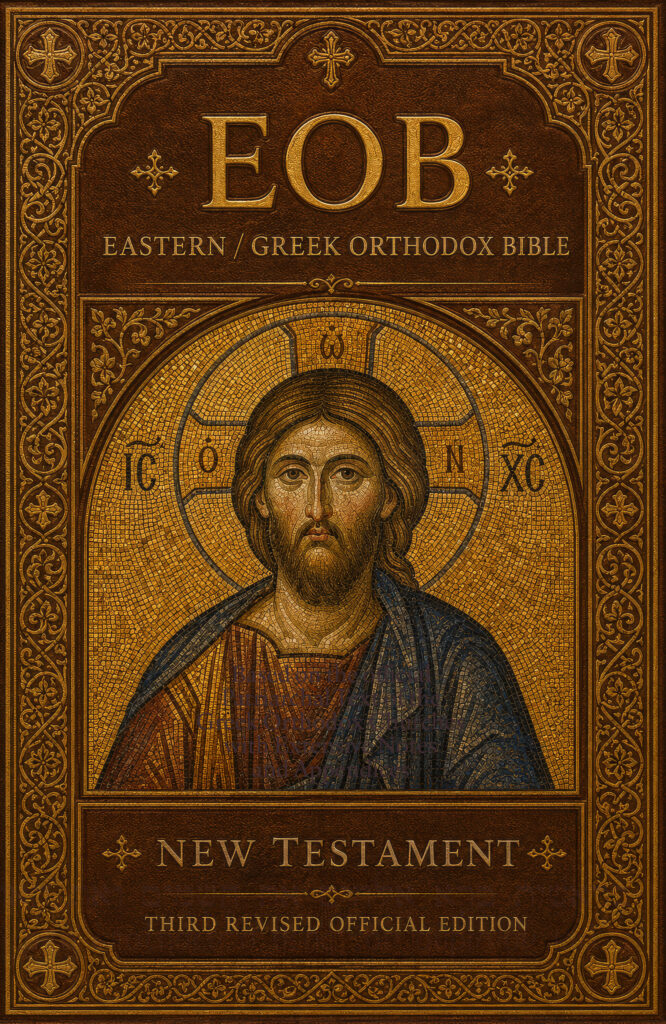
EOB: Official Site of the Eastern / Greek Orthodox Bible (Old and New Testament)
EOB (Eastern / Greek Orthodox Bible):
EOB Footnote:
KJV (King James Version):
WEB (World English Bible):
Benton LXX (Vaticanus):
Douai-Rheims (Vulgate):
Apostoliki Diakonia (LXX):
YLT (Young Literal Translation )(MT):
BBE (Bible in Basic English):
EOB Commentary:
Genesis 4:18 – Commentary
This verse presents the genealogy descending from Cain through Enoch, recording the line: Enoch begat Irad, Irad begat Mehujael, Mehujael begat Methushael, and Methushael begat Lamech.
Patristic Interpretation: The Church Fathers consistently viewed the genealogy of Cain as representing the development of the “city of man” in contrast to the godly line of Seth. Saint Augustine, in his City of God, extensively develops this theme, seeing in Cain’s descendants the progressive movement away from God and toward worldly civilization built on human pride rather than divine grace. The names themselves were sometimes interpreted allegorically by the Fathers, though such interpretations varied.
Typological Significance: The Orthodox tradition recognizes a deliberate parallel structure between the genealogies of Cain and Seth. Both lines contain an Enoch and a Lamech, yet their characters differ dramatically. Cain’s Enoch has a city named after him, representing earthly glory, while Seth’s Enoch “walked with God” and was translated. This contrast prefigures the New Testament distinction between those who are “of the world” and those who are “in Christ.”
Spiritual Themes: The multiplication of Cain’s descendants reminds us that sin, once introduced, propagates through generations. Yet this genealogy also demonstrates God’s patience and common grace extended even to the line of the murderer. The Orthodox understanding of ancestral sin finds expression here—not that guilt is inherited, but that the consequences and tendencies of sin pass through human generations, requiring the healing that comes only through Christ, the New Adam.
Liturgical Connection: While this specific verse does not appear prominently in Orthodox liturgical texts, the broader theme of contrasting genealogies finds its fulfillment in the Gospel genealogies read during the Nativity season. Christ’s genealogy through both Matthew and Luke demonstrates that He comes to redeem all humanity—both the righteous and sinners—gathering into Himself the broken history of mankind to restore it.
The brevity and seemingly mundane nature of such genealogical verses should not obscure their theological purpose. They establish the historical continuity that the Incarnation requires and demonstrate that God works through real human history, with all its darkness and light, to accomplish salvation.
The Book of Leviticus receives its English title from the Latin Vulgate, which is derived from the Greek Septuagint (LXX) title Leuitikon (Λευιτικόν), meaning “Levitical” or “pertaining to the Levites.”

The Book of Exodus receives its English title from the Greek Septuagint (LXX), where it is called Exodos (Ἔξοδος), meaning “departure” or “exit.” This name was chosen because the central

I. Date and Authorship Holy Tradition of the Orthodox Church, affirmed by the Fathers and the liturgical usage of the Church from the earliest centuries, attributes the Book of Genesis

Does Hebrews 11 on the Maccabees Show Stronger Alignment with 4 Maccabees than 2 Maccabees? Hebrews 11 (the famous “Hall of Faith” chapter) does not explicitly mention the Maccabees by