Introduction to the book of Leviticus
The Book of Leviticus receives its English title from the Latin Vulgate, which is derived from the Greek Septuagint (LXX) title Leuitikon (Λευιτικόν), meaning “Levitical” or “pertaining to the Levites.”
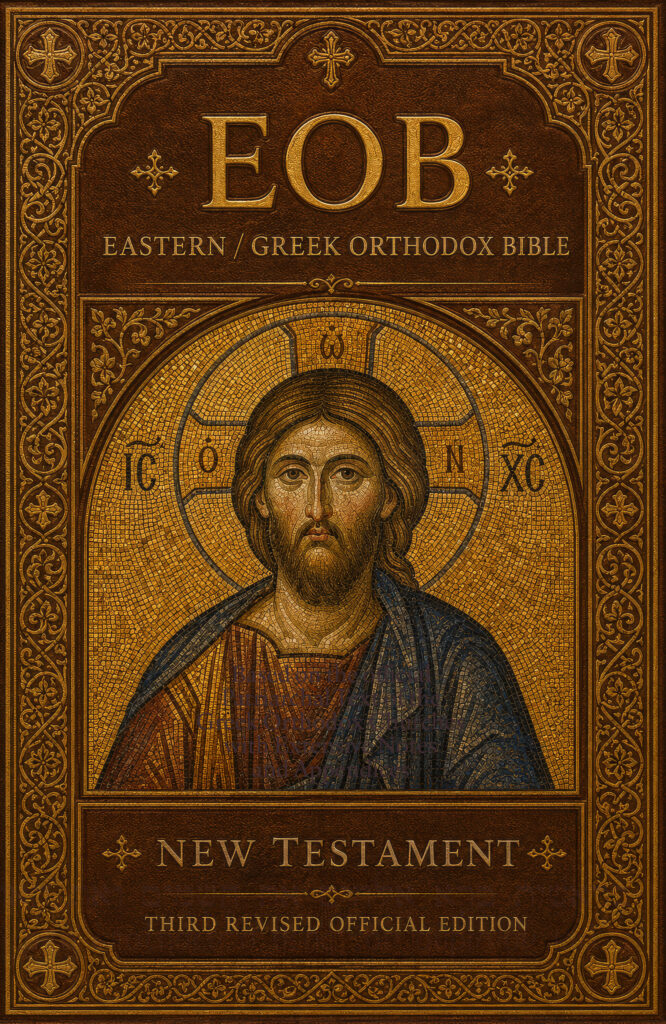
EOB: Official Site of the Eastern / Greek Orthodox Bible (Old and New Testament)
EOB (Eastern / Greek Orthodox Bible):
EOB Footnote:
KJV (King James Version):
WEB (World English Bible):
Benton LXX (Vaticanus):
Douai-Rheims (Vulgate):
Apostoliki Diakonia (LXX):
YLT (Young Literal Translation )(MT):
BBE (Bible in Basic English):
EOB Commentary:
GENESIS 4:19
Lamech and the Introduction of Polygamy
This verse marks a significant moment in the biblical narrative, as it records the first instance of polygamy in human history. Lamech, a descendant of Cain, takes two wives—Adah and Zillah—departing from the original divine institution of marriage established in Genesis 2:24, where one man cleaves to one wife.
Patristic Interpretation:
The Church Fathers consistently viewed Lamech’s polygamy as a corruption of God’s original design and a sign of the progressive moral deterioration within the line of Cain. Saint John Chrysostom observes that this departure from monogamy represents humanity’s increasing distance from paradise and the divine order. The multiplication of wives parallels the multiplication of sin, as Lamech’s household becomes associated with violence and boasting in bloodshed, as seen in the verses that follow.
Saint Ephrem the Syrian notes that while the righteous line of Seth preserved the original pattern of marriage, the Cainite line introduced innovations that distorted God’s purposes. This contrast between the two lineages prefigures the ongoing struggle between those who follow God’s commandments and those who fashion their own moral standards.
Christological and New Testament Significance:
Our Lord Jesus Christ explicitly restored the original meaning of marriage by pointing back to the creation account, stating that “from the beginning it was not so” (Matthew 19:8). Christ’s teaching on marriage as a union between one man and one woman stands as a direct correction of the distortions introduced by figures like Lamech. The Apostle Paul further develops this theology by presenting marriage as an icon of Christ and the Church (Ephesians 5:32), a mystery that requires the exclusive union of two becoming one flesh.
Liturgical and Spiritual Reflection:
In the Orthodox marriage service, the Church blesses the union of one man and one woman, invoking the original blessing of Adam and Eve. The crowning of the couple recalls their calling to be king and queen of a small kingdom—the domestic church—ordered according to God’s design rather than human innovation.
This verse serves as a sobering reminder that departure from divine commandments, even in matters that seem personal or private, has consequences that ripple through generations. The Orthodox spiritual tradition calls the faithful to discernment, recognizing that the patterns established in Genesis continue to instruct us about the nature of human relationships and our calling to live according to God’s original blessing rather than the corrupted innovations of a fallen world.
The Book of Leviticus receives its English title from the Latin Vulgate, which is derived from the Greek Septuagint (LXX) title Leuitikon (Λευιτικόν), meaning “Levitical” or “pertaining to the Levites.”

The Book of Exodus receives its English title from the Greek Septuagint (LXX), where it is called Exodos (Ἔξοδος), meaning “departure” or “exit.” This name was chosen because the central

I. Date and Authorship Holy Tradition of the Orthodox Church, affirmed by the Fathers and the liturgical usage of the Church from the earliest centuries, attributes the Book of Genesis

Does Hebrews 11 on the Maccabees Show Stronger Alignment with 4 Maccabees than 2 Maccabees? Hebrews 11 (the famous “Hall of Faith” chapter) does not explicitly mention the Maccabees by