Introduction to the book of Leviticus
The Book of Leviticus receives its English title from the Latin Vulgate, which is derived from the Greek Septuagint (LXX) title Leuitikon (Λευιτικόν), meaning “Levitical” or “pertaining to the Levites.”
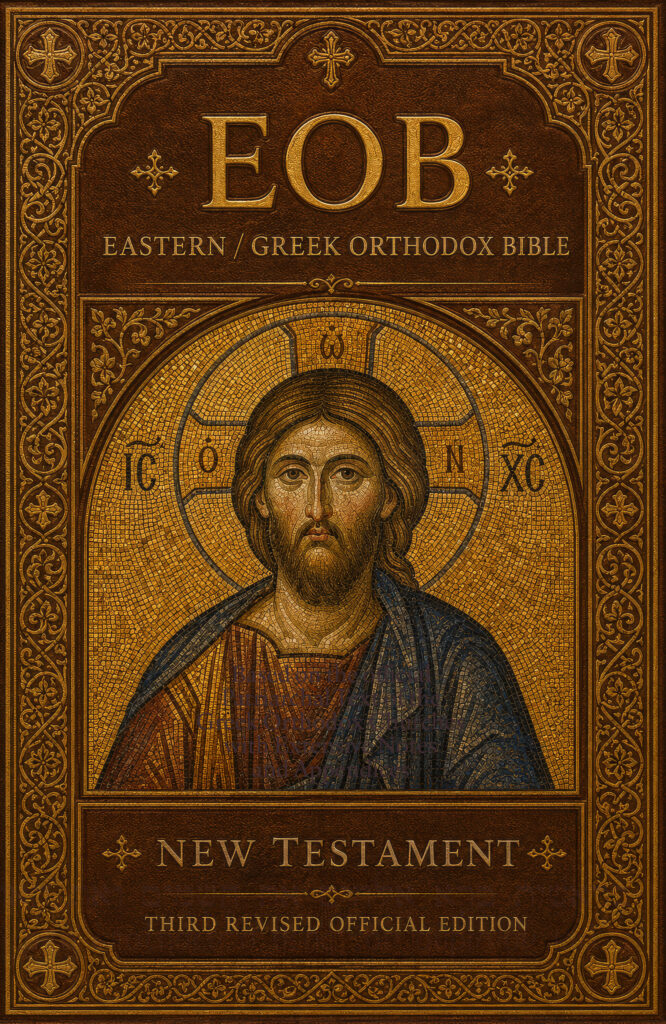
EOB: Official Site of the Eastern / Greek Orthodox Bible (Old and New Testament)
EOB (Eastern / Greek Orthodox Bible):
EOB Footnote:
KJV (King James Version):
WEB (World English Bible):
Benton LXX (Vaticanus):
Douai-Rheims (Vulgate):
Apostoliki Diakonia (LXX):
YLT (Young Literal Translation )(MT):
BBE (Bible in Basic English):
EOB Commentary:
GENESIS 4:21 – JUBAL, FATHER OF MUSICIANS
This verse introduces Jubal as the originator of musical instruments, specifically the harp (kinnor) and pipe (ugav). While seemingly a brief genealogical note, this passage carries significant theological weight in Orthodox tradition, touching upon the nature of human creativity, the ambiguity of cultural achievements within the line of Cain, and the ultimate redemption of music in divine worship.
Patristic Interpretation: The Church Fathers approached this verse with nuanced reflection. Saint John Chrysostom and others noted that while the descendants of Cain developed arts and crafts, these achievements emerged from a lineage marked by sin and separation from God. Yet the Fathers did not condemn music itself; rather, they recognized that human creativity, though exercised by fallen humanity, reflects the image of God within us. Saint Basil the Great, in his homilies on the Psalms, would later affirm that musical instruments, when directed toward the praise of God, become sanctified tools of worship.
Liturgical Significance: Orthodox liturgical tradition has transformed the legacy of Jubal. While the Orthodox Church historically favors unaccompanied vocal music in worship, emphasizing the human voice as the most fitting instrument for divine praise, the theological principle remains: music belongs ultimately to God. The Psalter, central to Orthodox worship, repeatedly calls for instrumental praise. The hymnography of the Church—from the kontakia of Saint Romanos the Melodist to the compositions of Saint John of Damascus—represents the redemption of musical art for sacred purposes.
Christological Reading: Some patristic interpreters saw in the development of music a preparation for the hymns that would eventually glorify Christ. The instruments invented by Jubal find their fulfillment not in worldly entertainment but in the ceaseless doxology of the heavenly hosts, joined by the earthly Church. The harp of David, descendant of the line of Seth rather than Cain, would produce the Psalms that prophesy Christ and form the backbone of Orthodox prayer.
Spiritual Reflection: This verse invites reflection on the proper use of human talents. The Orthodox spiritual tradition teaches that every gift, including artistic ability, must be offered back to God. What began in the city of Cain—a civilization built in defiance of divine judgment—is transfigured in the Church, where music becomes theophany, a vehicle of grace drawing the faithful toward the Kingdom. The fathers of instruments in Genesis find their true purpose fulfilled in those who compose and chant for the glory of the Holy Trinity.
The Book of Leviticus receives its English title from the Latin Vulgate, which is derived from the Greek Septuagint (LXX) title Leuitikon (Λευιτικόν), meaning “Levitical” or “pertaining to the Levites.”

The Book of Exodus receives its English title from the Greek Septuagint (LXX), where it is called Exodos (Ἔξοδος), meaning “departure” or “exit.” This name was chosen because the central

I. Date and Authorship Holy Tradition of the Orthodox Church, affirmed by the Fathers and the liturgical usage of the Church from the earliest centuries, attributes the Book of Genesis

Does Hebrews 11 on the Maccabees Show Stronger Alignment with 4 Maccabees than 2 Maccabees? Hebrews 11 (the famous “Hall of Faith” chapter) does not explicitly mention the Maccabees by