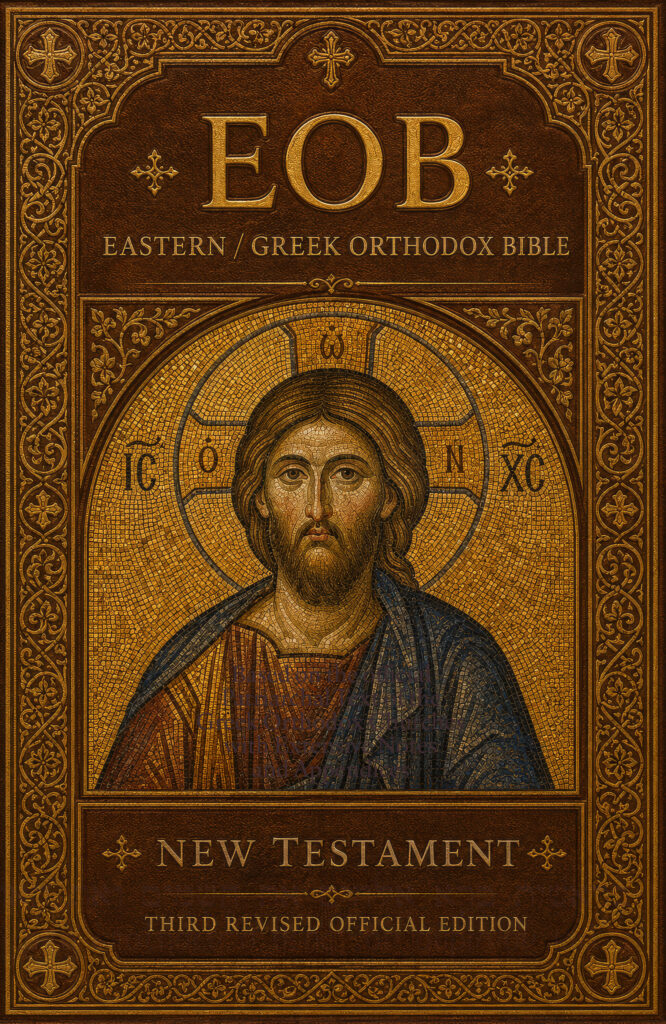
EOB: Official Site of the Eastern / Greek Orthodox Bible (Old and New Testament)

Genesis 4:5

EOB (Eastern / Greek Orthodox Bible):

But Cain and his offering weren’t accepted. Cain got really mad and his face showed it.

EOB Footnote:

The MT includes the phrase “and his face fell” at the end of the verse, which is also present in the LXX. The MT reads literally “to Cain and to his offering he did not look” where the LXX has a similar construction. No significant textual variants exist between the major witnesses for this verse.

Other Translations:

KJV (King James Version):

But unto Cain and to his offering he had not respect. And Cain was very wroth, and his countenance fell.

WEB (World English Bible):

but he didn’t respect Cain and his offering. Cain was very angry, and the expression on his face fell.

Benton LXX (Vaticanus):

But Cain and his sacrifices he regarded not, and Cain was exceedingly sorrowful and his countenance fell.

Douai-Rheims (Vulgate):

But to Cain and his offerings he had no respect: and Cain was exceeding angry, and his countenance fell.

Apostoliki Diakonia (LXX):

but on Cain and his offering he did not look with favor. So Cain was very angry, and his face was downcast.

YLT (Young Literal Translation )(MT):

but to Cain and to his offering He did not look; and it displeased Cain exceedingly, and his countenance fell.

BBE (Bible in Basic English):

But in Cain and his offering he had no pleasure. And Cain was angry and his face became sad.

EOB COMMENTARY:

EOB Commentary:

GENESIS 4:5

The Divine Rejection and the Mystery of Acceptable Worship

The Lord’s refusal to regard Cain’s offering while accepting Abel’s sacrifice presents one of Scripture’s earliest and most profound mysteries concerning true worship. This verse establishes a pattern that reverberates throughout salvation history and finds its ultimate resolution in Christ.

Patristic Interpretation: The Church Fathers consistently understood this rejection not as arbitrary divine caprice but as a response to the interior disposition of the worshiper. Saint John Chrysostom teaches that God looked first upon the hearts of the brothers before examining their offerings. The deficiency lay not in the material gift itself but in the spiritual poverty with which it was presented. Saint Ephrem the Syrian similarly emphasizes that Cain’s offering lacked the firstfruits quality—he gave merely from his produce, while Abel offered the choicest portions. This distinction between perfunctory religious observance and wholehearted devotion remains central to Orthodox spiritual life.

Christological Significance: The Epistle to the Hebrews explicitly references this event, declaring that “by faith Abel offered to God a more excellent sacrifice than Cain” (Hebrews 11:4). Abel thus becomes a type of Christ—the righteous one whose offering is accepted and who suffers death at the hands of his brother. Christ Himself invokes Abel’s blood as the beginning of righteous bloodshed that culminates in His own Passion (Matthew 23:35). The accepted sacrifice of Abel prefigures the one perfect sacrifice of the Lamb of God.

Liturgical Resonance: In the Divine Liturgy of Saint Basil the Great, the Anaphora recalls Abel among the righteous whose offerings pleased God, placing his sacrifice within the great chain of acceptable worship that finds completion in the Eucharist. The Orthodox understanding that the disposition of the heart determines the acceptability of worship directly shapes liturgical spirituality—hence the repeated calls to “lift up our hearts” and to approach the holy mysteries with fear, faith, and love.

Spiritual Application: This verse warns against the danger of external religiosity divorced from inner transformation. The fallen countenance of Cain that follows reveals how rejected worship, when met with pride rather than repentance, leads to spiritual catastrophe. Orthodox ascetical tradition emphasizes that prayer, fasting, and almsgiving offered without humility and love become spiritually barren. The Jesus Prayer tradition and the entire hesychast emphasis on guarding the heart find their scriptural foundation in passages such as this, where God’s penetrating gaze discerns the hidden movements of the soul beneath all outward religious performance.

Introduction to the book of Leviticus

The Book of Leviticus receives its English title from the Latin Vulgate, which is derived from the Greek Septuagint (LXX) title Leuitikon (Λευιτικόν), meaning “Levitical” or “pertaining to the Levites.”

Read More »

Introduction to the book of Exodus

The Book of Exodus receives its English title from the Greek Septuagint (LXX), where it is called Exodos (Ἔξοδος), meaning “departure” or “exit.” This name was chosen because the central

Read More »