Introduction to the book of Leviticus
The Book of Leviticus receives its English title from the Latin Vulgate, which is derived from the Greek Septuagint (LXX) title Leuitikon (Λευιτικόν), meaning “Levitical” or “pertaining to the Levites.”
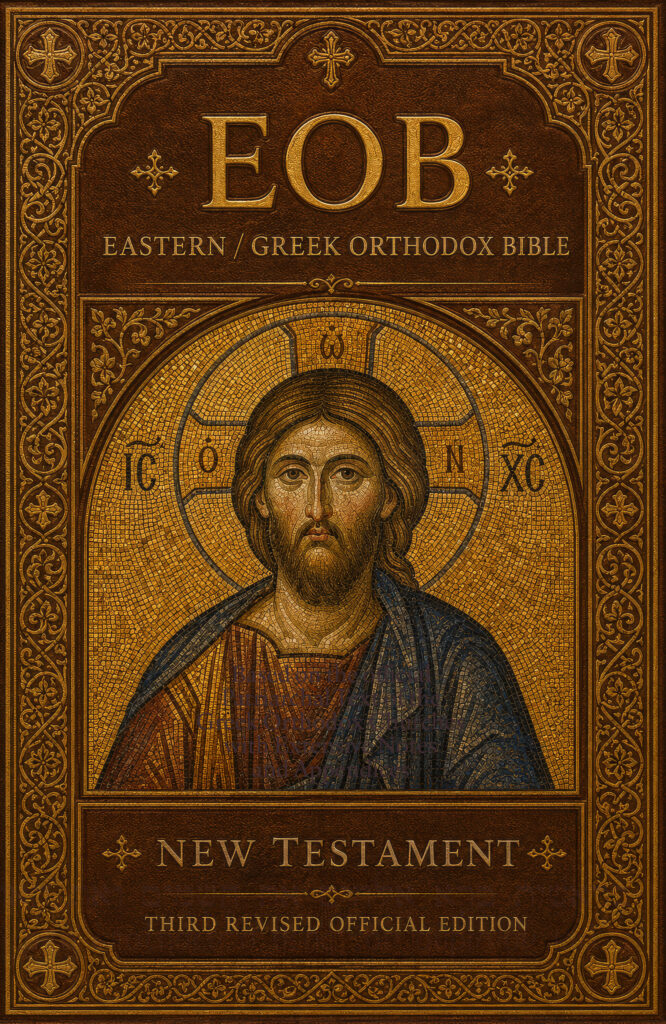
EOB: Official Site of the Eastern / Greek Orthodox Bible (Old and New Testament)
EOB (Eastern / Greek Orthodox Bible):
EOB Footnote:
KJV (King James Version):
WEB (World English Bible):
Benton LXX (Vaticanus):
Douai-Rheims (Vulgate):
Apostoliki Diakonia (LXX):
YLT (Young Literal Translation )(MT):
BBE (Bible in Basic English):
EOB Commentary:
Genesis 4:7
The Divine Warning and the Crouching Beast
This verse presents one of the most profound early revelations concerning the nature of sin and human moral responsibility. God speaks directly to Cain before the murder of Abel, offering both warning and hope. The imagery of sin “crouching at the door” (in the Septuagint, the word used suggests a wild beast lying in wait) presents sin as a predatory force seeking to devour the unwary soul.
Christological and Soteriological Significance:
The promise that Cain may “rule over” sin points forward to the victory that Christ would accomplish over sin and death. Where Cain failed to master the beast at his door, the New Adam succeeded perfectly. Christ’s temptation in the wilderness demonstrates His mastery over the ancient serpent, and His death and resurrection crush the power of sin that has crouched at humanity’s door since the Fall. Saint Paul’s teaching that sin shall not have dominion over those in Christ echoes this ancient promise of potential victory.
Patristic Interpretation:
Saint John Chrysostom emphasizes that this verse demonstrates God’s mercy in warning Cain before his transgression, showing that the Lord desires repentance rather than punishment. Chrysostom notes that God reveals the remedy before the disease fully manifests, teaching that divine grace always precedes and enables human choice. Saint Ephrem the Syrian interprets the crouching sin as the demonic influence that exploits human passion, particularly envy, which he identifies as the root of Cain’s murderous intent.
Liturgical and Spiritual Connections:
The image of sin waiting at the threshold resonates deeply with Orthodox ascetical teaching on watchfulness (nepsis). The Jesus Prayer tradition and the entire hesychast spiritual practice address precisely this reality—the need for constant vigilance against the passions that crouch at the door of the heart. During Great Lent, the Church calls the faithful to intensified spiritual combat, recognizing that sin perpetually seeks entry into the soul.
The verse also illuminates the Orthodox understanding of synergy between divine grace and human will. God offers Cain the possibility of acceptance and victory, but Cain must choose to exercise dominion over sin. This balance between divine initiative and human response remains central to Orthodox soteriology, rejecting both Pelagian self-sufficiency and any notion that renders human choice meaningless.
The tragedy that follows—Cain’s rejection of this warning—serves as a perpetual reminder that God’s grace, while always offered, must be freely received and acted upon through the cooperation of the human will illumined by divine mercy.
The Book of Leviticus receives its English title from the Latin Vulgate, which is derived from the Greek Septuagint (LXX) title Leuitikon (Λευιτικόν), meaning “Levitical” or “pertaining to the Levites.”

The Book of Exodus receives its English title from the Greek Septuagint (LXX), where it is called Exodos (Ἔξοδος), meaning “departure” or “exit.” This name was chosen because the central

I. Date and Authorship Holy Tradition of the Orthodox Church, affirmed by the Fathers and the liturgical usage of the Church from the earliest centuries, attributes the Book of Genesis

Does Hebrews 11 on the Maccabees Show Stronger Alignment with 4 Maccabees than 2 Maccabees? Hebrews 11 (the famous “Hall of Faith” chapter) does not explicitly mention the Maccabees by