Introduction to the book of Leviticus
The Book of Leviticus receives its English title from the Latin Vulgate, which is derived from the Greek Septuagint (LXX) title Leuitikon (Λευιτικόν), meaning “Levitical” or “pertaining to the Levites.”
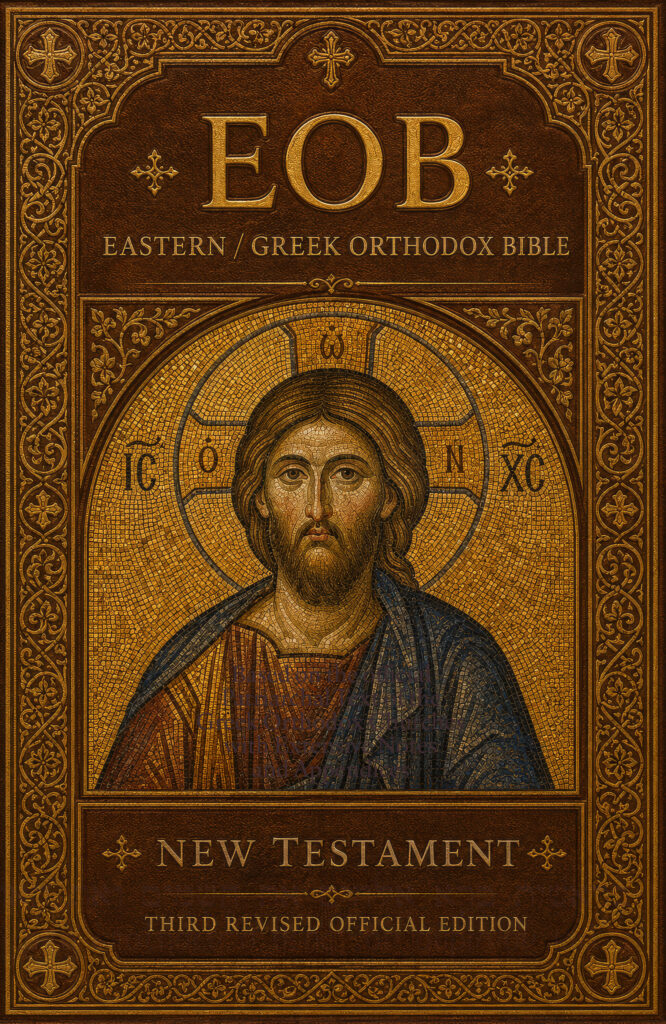
EOB: Official Site of the Eastern / Greek Orthodox Bible (Old and New Testament)
EOB (Eastern / Greek Orthodox Bible):
EOB Footnote:
KJV (King James Version):
WEB (World English Bible):
Benton LXX (Vaticanus):
Douai-Rheims (Vulgate):
Apostoliki Diakonia (LXX):
YLT (Young Literal Translation )(MT):
BBE (Bible in Basic English):
EOB Commentary:
Genesis 5:12
Cainan lived seventy years and begot Mahalalel.
This verse continues the genealogical record of the line of Seth, tracing the ancestry from Adam through to Noah. While appearing as a simple chronological notation, this passage carries significance within the broader theological framework of Orthodox Christianity.
Christological and New Testament Significance:
The importance of Cainan in this genealogy becomes evident when we turn to the Gospel of Luke. In Luke 3:37, the evangelist includes Cainan (rendered as Kainan or Cainam in various manuscripts) in the genealogy of our Lord Jesus Christ, tracing His lineage back through the patriarchs to Adam and ultimately to God. This demonstrates that every name in the Genesis genealogies participates in the sacred history of salvation, forming links in the chain that connects the first Adam to the Second Adam, Christ our Lord. The Orthodox Church understands these genealogies not merely as historical records but as testimonies to God’s providential care in preserving the messianic line through which the Savior would come.
Patristic Reflection:
The Church Fathers, including Saint Augustine and others, noted that the genealogies of Genesis chapter five stand in deliberate contrast to the genealogy of Cain in chapter four. While Cain’s line culminates in Lamech’s boast of violence and vengeance, Seth’s line through figures like Cainan leads ultimately to Noah, the righteous one through whom humanity would be preserved. This typological reading sees in the Sethite genealogy a foreshadowing of the Church—the community of the faithful preserved through the waters of judgment, just as believers are saved through the waters of baptism.
Liturgical and Spiritual Themes:
The naming of Mahalalel, whose name means “praise of God,” reminds the faithful that even in genealogical records, the praise of the Creator remains central. Orthodox spirituality recognizes that human generations exist not merely for biological continuation but for the glorification of God. Each generation carries forward the divine image and the hope of restoration.
The extended lifespans recorded in this chapter have been understood by Orthodox interpreters as reflecting both the relative proximity to the original creation and the gradual effects of the Fall upon human nature. These long lives allowed for the transmission of sacred tradition from Adam through relatively few generations to Noah and beyond, preserving the knowledge of God and His promises.
The Book of Leviticus receives its English title from the Latin Vulgate, which is derived from the Greek Septuagint (LXX) title Leuitikon (Λευιτικόν), meaning “Levitical” or “pertaining to the Levites.”

The Book of Exodus receives its English title from the Greek Septuagint (LXX), where it is called Exodos (Ἔξοδος), meaning “departure” or “exit.” This name was chosen because the central

I. Date and Authorship Holy Tradition of the Orthodox Church, affirmed by the Fathers and the liturgical usage of the Church from the earliest centuries, attributes the Book of Genesis

Does Hebrews 11 on the Maccabees Show Stronger Alignment with 4 Maccabees than 2 Maccabees? Hebrews 11 (the famous “Hall of Faith” chapter) does not explicitly mention the Maccabees by