Introduction to the book of Leviticus
The Book of Leviticus receives its English title from the Latin Vulgate, which is derived from the Greek Septuagint (LXX) title Leuitikon (Λευιτικόν), meaning “Levitical” or “pertaining to the Levites.”
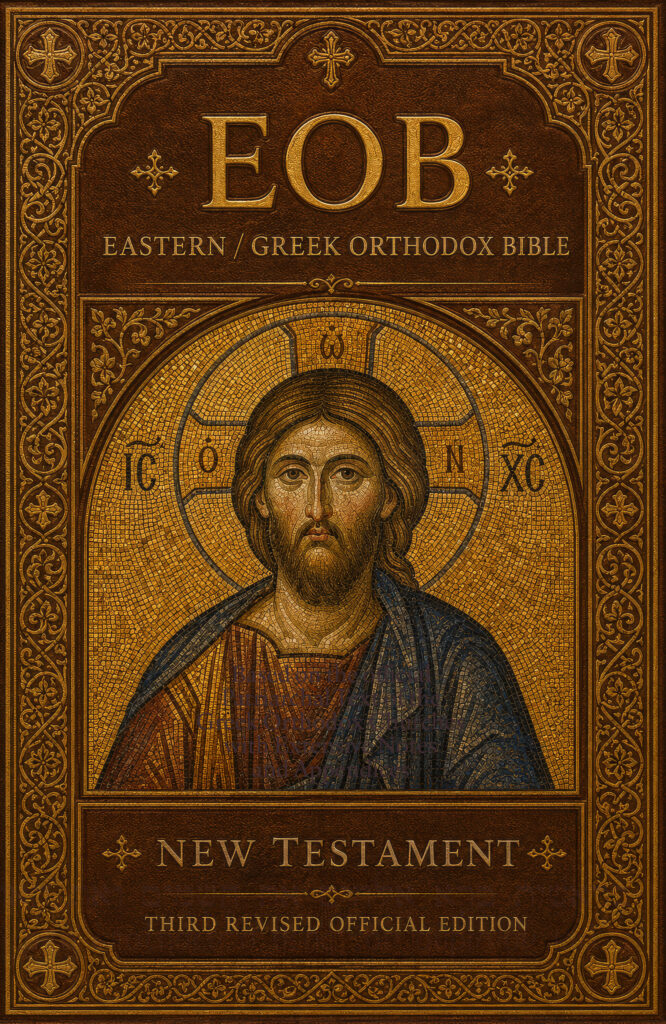
EOB: Official Site of the Eastern / Greek Orthodox Bible (Old and New Testament)
EOB (Eastern / Greek Orthodox Bible):
EOB Footnote:
KJV (King James Version):
WEB (World English Bible):
Benton LXX (Vaticanus):
Douai-Rheims (Vulgate):
Apostoliki Diakonia (LXX):
YLT (Young Literal Translation )(MT):
BBE (Bible in Basic English):
EOB Commentary:
Genesis 5:16
And Mahalalel lived after he begat Jared eight hundred and thirty years, and begat sons and daughters.
This verse continues the genealogical record of the antediluvian patriarchs, documenting the life of Mahalalel following the birth of his son Jared. While appearing as a simple chronological notation, this passage carries significance within the broader theological framework of Orthodox interpretation.
Christological and New Testament Significance:
The genealogy of Genesis 5 finds its ultimate fulfillment in the Gospel of Luke, where the evangelist traces the ancestry of Christ back through these very patriarchs to Adam and ultimately to God Himself (Luke 3:37). Mahalalel appears in this sacred lineage, demonstrating that even these seemingly mundane verses participate in the divine economy of salvation. Each generation preserved the messianic line through which the Theotokos would eventually bring forth the Incarnate Word. The extended lifespans of these patriarchs, including Mahalalel’s total of 895 years, point to humanity’s original created dignity before the full effects of the Fall had diminished human vitality.
Patristic Interpretation:
The Church Fathers understood these genealogies as more than historical records. Saint Augustine noted that the longevity of the patriarchs served divine providence, allowing for the preservation and transmission of sacred knowledge across fewer generations. The name Mahalalel itself, meaning “praise of God” or “one who praises God,” was seen by interpreters as spiritually significant, suggesting that even in the generations following the Fall, humanity maintained its fundamental vocation of glorifying the Creator.
Liturgical and Spiritual Themes:
The Orthodox Church commemorates the holy forefathers in the weeks preceding the Nativity of Christ, recognizing figures like Mahalalel as participants in the long preparation for the Incarnation. The phrase “begat sons and daughters” reminds us of the blessing of fruitfulness given at creation, a blessing that the Church continues to invoke in the Mystery of Marriage. The multiplication of humanity, despite the presence of sin, reflects God’s patient work toward redemption.
The extended years granted to these patriarchs also invite reflection on the Orthodox understanding of theosis. Before the Flood, humanity retained greater proximity to its original created state, and these long lives may be understood as vestiges of the immortality for which we were created and to which we are called through union with Christ. The genealogies thus serve as a bridge connecting protology and eschatology, creation and final restoration.
The Book of Leviticus receives its English title from the Latin Vulgate, which is derived from the Greek Septuagint (LXX) title Leuitikon (Λευιτικόν), meaning “Levitical” or “pertaining to the Levites.”

The Book of Exodus receives its English title from the Greek Septuagint (LXX), where it is called Exodos (Ἔξοδος), meaning “departure” or “exit.” This name was chosen because the central

I. Date and Authorship Holy Tradition of the Orthodox Church, affirmed by the Fathers and the liturgical usage of the Church from the earliest centuries, attributes the Book of Genesis

Does Hebrews 11 on the Maccabees Show Stronger Alignment with 4 Maccabees than 2 Maccabees? Hebrews 11 (the famous “Hall of Faith” chapter) does not explicitly mention the Maccabees by