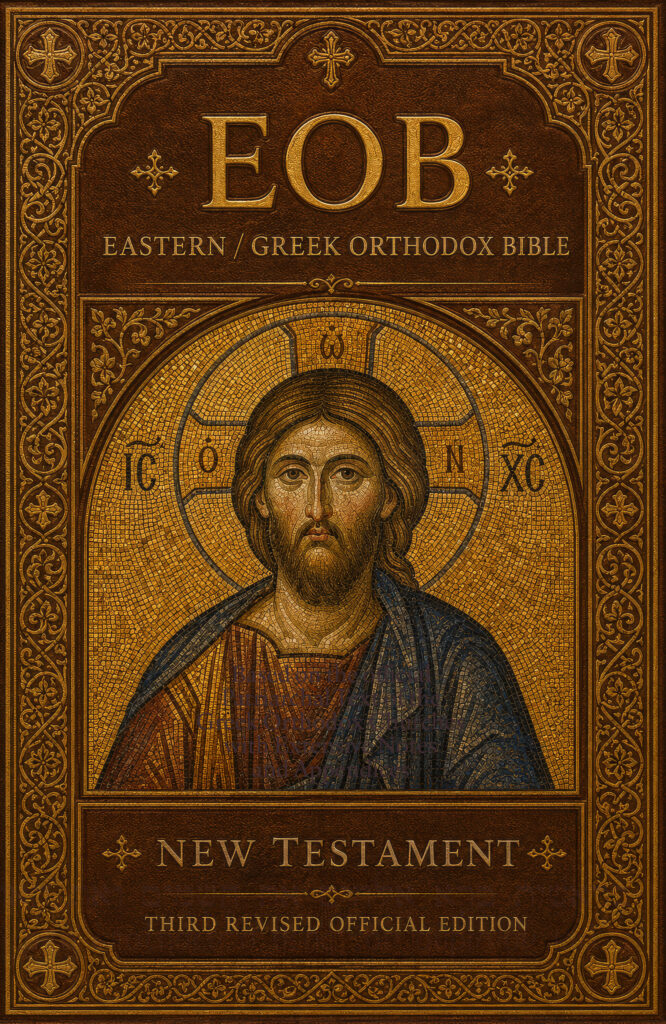
EOB: Official Site of the Eastern / Greek Orthodox Bible (Old and New Testament)

Genesis 5:19

EOB (Eastern / Greek Orthodox Bible):

After Enoch was born, Jared lived for eight hundred years. He also had more sons and daughters.

EOB Footnote:

The MT reads “Jared” where the LXX reads “Iared,” reflecting standard transliteration differences between Hebrew and Greek forms of the name. No DSS manuscript witness exists for this verse. The numbers for Jared’s remaining years after fathering Enoch agree between the LXX and MT at 800 years.

Other Translations:

KJV (King James Version):

And Jared lived after he begat Enoch eight hundred years, and begat sons and daughters.

WEB (World English Bible):

After he became the father of Enoch, Jared lived eight hundred years, and became the father of other sons and daughters.

Benton LXX (Vaticanus):

And Seth lived one hundred and seventy years, and begot Enos.

Douai-Rheims (Vulgate):

And Jared lived after he begot Enoch, eight hundred years, and begot sons and daughters.

Apostoliki Diakonia (LXX):

After Methuselah had fathered Lamech, he lived seven hundred and eighty-two years and had other sons and daughters.

YLT (Young Literal Translation )(MT):

And Jared lived after he begot Enoch eight hundred years, and begot sons and daughters.

BBE (Bible in Basic English):

And after the birth of Enosh, Seth went on living for eight hundred and seven years, and had sons and daughters.

EOB COMMENTARY:

EOB Commentary:

Genesis 5:19

And Jared lived after he begot Enoch eight hundred years, and begot sons and daughters.

This verse, while part of the genealogical record of the antediluvian patriarchs, carries significance primarily through its connection to the figure of Enoch and the broader theological framework of the Genesis genealogies.

Christological and Typological Significance:
The genealogy of Genesis 5 traces the line from Adam to Noah, establishing the lineage through which the promise of salvation would be preserved. This same genealogical thread is taken up by Saint Luke in his Gospel (Luke 3:37), where Jared appears in the ancestry of our Lord Jesus Christ. The extraordinary lifespans recorded in this chapter, including Jared’s total of 962 years, point to humanity’s original created goodness and the gradual effects of the Fall upon human nature. Christ, as the New Adam, comes to restore what was lost and to grant eternal life that surpasses even these remarkable years.

Patristic Reflection:
The Fathers generally understood these genealogies as historical records demonstrating God’s providential care for the righteous line. Saint Augustine notes that these long lives allowed for the rapid multiplication of humanity and the preservation of sacred tradition through direct oral transmission across many generations. The fact that Jared fathered Enoch, who would later be taken by God without experiencing death, gives this otherwise unremarkable verse a connection to one of the most mysterious figures in Scripture.

Liturgical Connection:
The genealogy of Genesis 5 is read during the Vesperal Liturgy on Holy Saturday, when the Church recounts salvation history from creation to the Resurrection. In this context, each patriarch represents a link in the chain of God’s faithfulness, leading ultimately to Christ who descends into Hades and raises Adam and all the righteous forefathers.

Spiritual Themes:
The phrase “and begot sons and daughters” reminds us that the patriarchs lived ordinary family lives while participating in God’s salvific plan. Orthodox spirituality recognizes that holiness is not separate from the responsibilities of marriage and parenthood. The faithful transmission of life and faith from generation to generation remains central to the Church’s understanding of family as the domestic church.

Introduction to the book of Leviticus

The Book of Leviticus receives its English title from the Latin Vulgate, which is derived from the Greek Septuagint (LXX) title Leuitikon (Λευιτικόν), meaning “Levitical” or “pertaining to the Levites.”

Read More »

Introduction to the book of Exodus

The Book of Exodus receives its English title from the Greek Septuagint (LXX), where it is called Exodos (Ἔξοδος), meaning “departure” or “exit.” This name was chosen because the central

Read More »