Introduction to the book of Leviticus
The Book of Leviticus receives its English title from the Latin Vulgate, which is derived from the Greek Septuagint (LXX) title Leuitikon (Λευιτικόν), meaning “Levitical” or “pertaining to the Levites.”
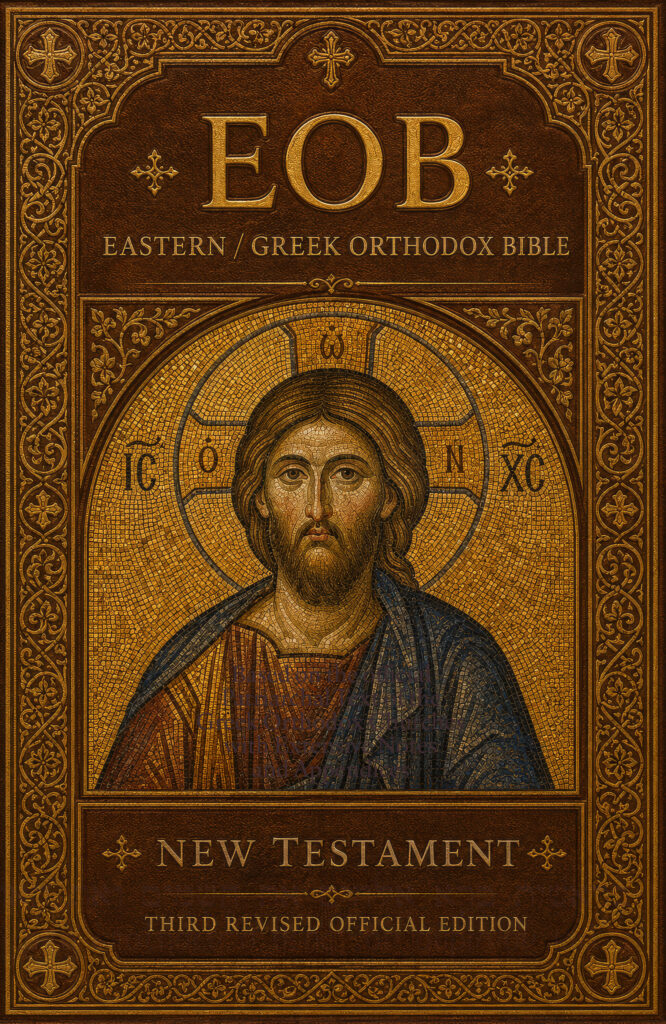
EOB: Official Site of the Eastern / Greek Orthodox Bible (Old and New Testament)
EOB (Eastern / Greek Orthodox Bible):
EOB Footnote:
KJV (King James Version):
WEB (World English Bible):
Benton LXX (Vaticanus):
Douai-Rheims (Vulgate):
Apostoliki Diakonia (LXX):
YLT (Young Literal Translation )(MT):
BBE (Bible in Basic English):
EOB Commentary:
GENESIS 5:23
And all the days of Enoch were three hundred sixty and five years.
The brevity of Enoch’s earthly sojourn stands in striking contrast to the other antediluvian patriarchs, whose lifespans extended well beyond nine hundred years. Yet this apparent shortness conceals a profound mystery, for Enoch’s abbreviated time on earth was not due to death but to translation. The number 365 itself carries symbolic weight, corresponding to the days of the solar year, suggesting a completeness and fullness of time in Enoch’s walk with God.
Patristic Interpretation: The Fathers saw in Enoch’s years a figure of the Church’s pilgrimage through temporal existence. Saint Ephrem the Syrian notes that Enoch lived fewer years than his ancestors precisely because he was more pleasing to God, demonstrating that length of days is not the measure of righteousness. Saint John Chrysostom emphasizes that Enoch’s relatively brief life teaches us that virtue, not longevity, constitutes true blessing.
Christological Significance: The Church Fathers perceived in Enoch a type of Christ’s Ascension. Just as Enoch was taken up without experiencing death after walking faithfully with God, so Christ ascended bodily into heaven. However, the typology operates by contrast as well as similarity: Enoch was translated as a righteous man preserved from corruption, while Christ ascended as the Victor over death itself, having trampled down death by death.
New Testament Connections: The Epistle to the Hebrews explicitly references Enoch’s translation, stating that “by faith Enoch was translated that he should not see death” (Hebrews 11:5). This apostolic interpretation confirms the Church’s understanding that Enoch’s departure from earthly life prefigured the resurrection hope. The epistle emphasizes that before his translation, Enoch “had this testimony, that he pleased God,” connecting his years of faithful walking directly to his extraordinary end.
Liturgical and Spiritual Themes: In Orthodox hymnography, Enoch appears alongside Elijah as witnesses to the possibility of bodily assumption into the heavenly realm, anticipating the general resurrection. The Sunday of the Holy Forefathers commemorates Enoch among those righteous ones who prepared the way for Christ’s coming. His 365 years remind the faithful that each day of our earthly pilgrimage should be lived in communion with God, walking before His face as Enoch walked. The completeness suggested by this solar number points toward the eschatological fulfillment when time itself shall be gathered into eternity.
The Book of Leviticus receives its English title from the Latin Vulgate, which is derived from the Greek Septuagint (LXX) title Leuitikon (Λευιτικόν), meaning “Levitical” or “pertaining to the Levites.”

The Book of Exodus receives its English title from the Greek Septuagint (LXX), where it is called Exodos (Ἔξοδος), meaning “departure” or “exit.” This name was chosen because the central

I. Date and Authorship Holy Tradition of the Orthodox Church, affirmed by the Fathers and the liturgical usage of the Church from the earliest centuries, attributes the Book of Genesis

Does Hebrews 11 on the Maccabees Show Stronger Alignment with 4 Maccabees than 2 Maccabees? Hebrews 11 (the famous “Hall of Faith” chapter) does not explicitly mention the Maccabees by