Introduction to the book of Leviticus
The Book of Leviticus receives its English title from the Latin Vulgate, which is derived from the Greek Septuagint (LXX) title Leuitikon (Λευιτικόν), meaning “Levitical” or “pertaining to the Levites.”
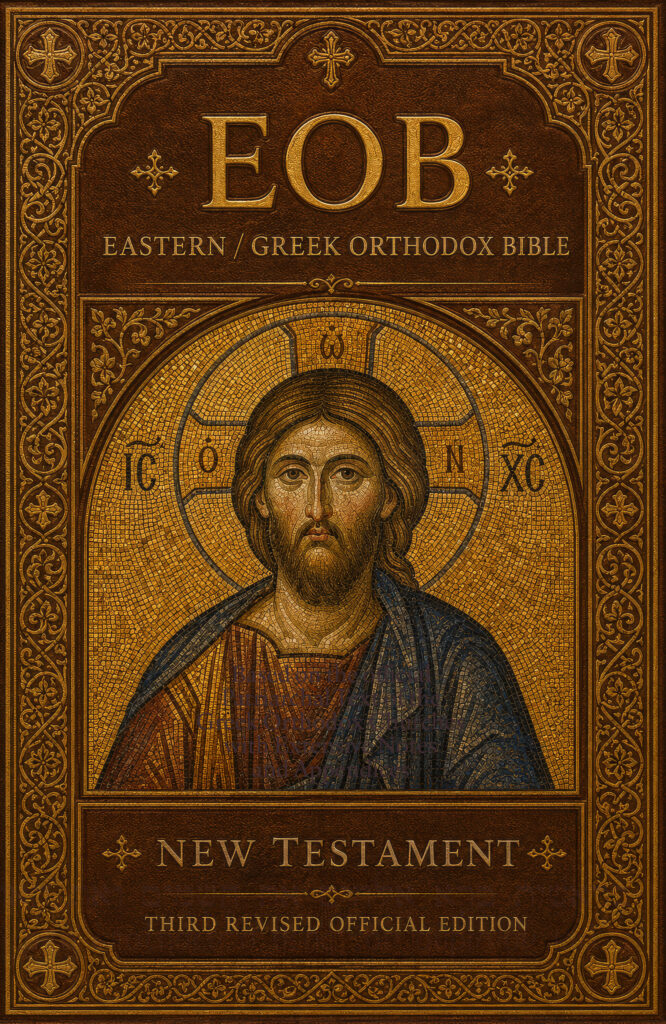
EOB: Official Site of the Eastern / Greek Orthodox Bible (Old and New Testament)
EOB (Eastern / Greek Orthodox Bible):
EOB Footnote:
KJV (King James Version):
WEB (World English Bible):
Benton LXX (Vaticanus):
Douai-Rheims (Vulgate):
Apostoliki Diakonia (LXX):
YLT (Young Literal Translation )(MT):
BBE (Bible in Basic English):
EOB Commentary:
Genesis 5:26
And Methuselah lived after he begat Lamech seven hundred eighty and two years, and begat sons and daughters.
This verse, part of the genealogy from Adam to Noah, appears at first glance to be a simple chronological notation. However, within the Orthodox understanding of Scripture, even such genealogical details carry theological weight.
Typological Significance: The genealogy of Genesis 5 establishes the line through which the promise of Genesis 3:15 would be fulfilled. Methuselah, whose name has been interpreted by some Fathers to mean “when he dies, it shall be sent,” stands as a silent witness to God’s patience. According to traditional chronology, Methuselah died in the very year of the Flood, his extraordinary lifespan of 969 years representing the long-suffering of God who delays judgment to allow for repentance. This theme resonates with the New Testament teaching that God “is longsuffering toward us, not willing that any should perish but that all should come to repentance” (2 Peter 3:9).
Christological Connection: The genealogy preserved here reappears in Luke 3:37, where the Evangelist traces Christ’s lineage back through Methuselah to Adam and ultimately to God. Thus this seemingly mundane verse participates in the great chain of human generations through which the Word became flesh. The Orthodox Church sees in these genealogies not mere historical record but the preparation of humanity for the Incarnation.
Patristic Reflection: Saint John Chrysostom, commenting on the Genesis genealogies, notes that Scripture records these generations to demonstrate both the continuity of God’s providential care and the reality of human mortality. Despite their remarkable longevity, each patriarch eventually died, fulfilling the sentence pronounced upon Adam. Only through Christ, the New Adam, would death itself be conquered.
Liturgical and Spiritual Themes: The remembrance of the righteous ancestors finds expression in the Orthodox liturgical calendar, particularly on the Sunday of the Holy Forefathers before the Nativity of Christ. The Church commemorates all those who, generation after generation, preserved faith in the coming Redeemer. The patience exhibited across these long lifespans teaches the faithful about perseverance in hope across the generations of the Church’s own pilgrimage toward the Second Coming.
The Book of Leviticus receives its English title from the Latin Vulgate, which is derived from the Greek Septuagint (LXX) title Leuitikon (Λευιτικόν), meaning “Levitical” or “pertaining to the Levites.”

The Book of Exodus receives its English title from the Greek Septuagint (LXX), where it is called Exodos (Ἔξοδος), meaning “departure” or “exit.” This name was chosen because the central

I. Date and Authorship Holy Tradition of the Orthodox Church, affirmed by the Fathers and the liturgical usage of the Church from the earliest centuries, attributes the Book of Genesis

Does Hebrews 11 on the Maccabees Show Stronger Alignment with 4 Maccabees than 2 Maccabees? Hebrews 11 (the famous “Hall of Faith” chapter) does not explicitly mention the Maccabees by