Introduction to the book of Leviticus
The Book of Leviticus receives its English title from the Latin Vulgate, which is derived from the Greek Septuagint (LXX) title Leuitikon (Λευιτικόν), meaning “Levitical” or “pertaining to the Levites.”
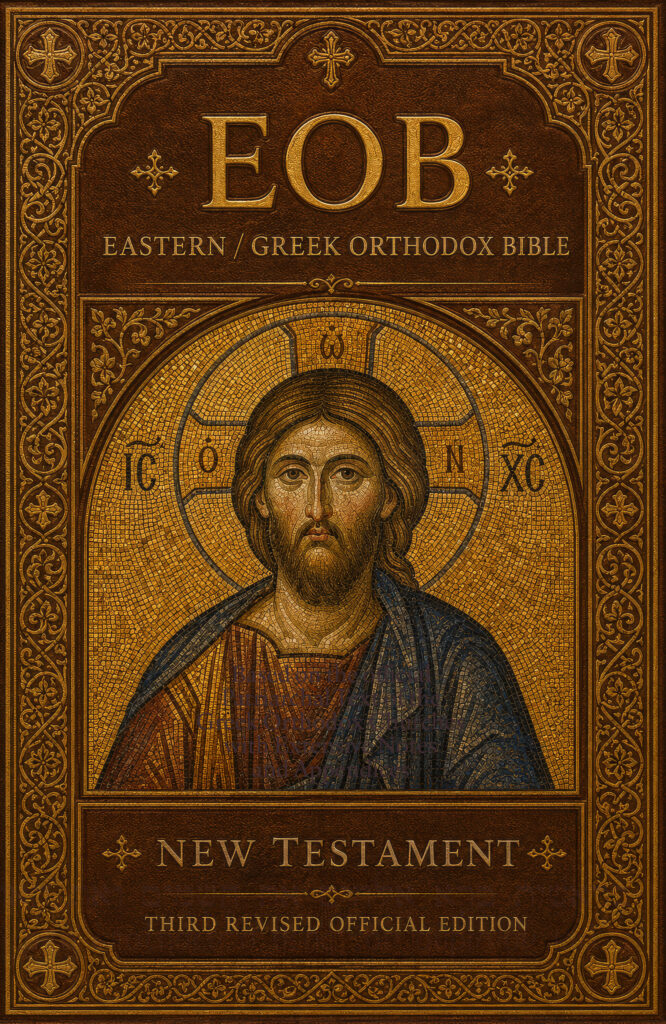
EOB: Official Site of the Eastern / Greek Orthodox Bible (Old and New Testament)
EOB (Eastern / Greek Orthodox Bible):
EOB Footnote:
KJV (King James Version):
WEB (World English Bible):
Benton LXX (Vaticanus):
Douai-Rheims (Vulgate):
Apostoliki Diakonia (LXX):
YLT (Young Literal Translation )(MT):
BBE (Bible in Basic English):
EOB Commentary:
Genesis 5:27 – Commentary
The Record of Methuselah’s Years
This verse records that Methuselah lived nine hundred sixty-nine years, making him the longest-lived human being in all of Scripture. While this may appear to be merely a genealogical notation, the Orthodox tradition finds profound theological significance in this detail.
Patristic Interpretation: The Church Fathers understood the extraordinary lifespans of the antediluvian patriarchs as reflecting humanity’s original constitution before the progressive effects of sin fully corrupted human nature. Saint John Chrysostom notes that these long lives served divine providence, allowing for the rapid population of the earth and the transmission of sacred knowledge from Adam through relatively few generations. Saint Ephrem the Syrian similarly observes that Methuselah could have personally known Adam and lived to see Noah complete the ark, thus serving as a living bridge of testimony across the ages.
Typological Significance: Orthodox interpreters have long noted that the name Methuselah (Methoushelach) can be understood to mean “when he dies, it shall be sent” or “his death shall bring.” Remarkably, calculating from the genealogies, Methuselah died in the very year of the Flood. His unprecedented longevity thus becomes a sign of God’s patience and long-suffering, delaying judgment to allow for repentance. This prefigures the patience of God described by the Apostle Peter, who explicitly connects the days of Noah with divine forbearance (1 Peter 3:20, 2 Peter 3:9).
Christological Connection: The extended mercy shown through Methuselah’s years points toward the ultimate expression of divine patience in Christ. Just as God delayed the waters of judgment during Methuselah’s lifetime, so too does He delay the final judgment, desiring all to come to salvation through His Son. The ark that Noah built during his grandfather’s final years becomes a type of the Church and of baptism, as the Orthodox baptismal liturgy affirms.
Liturgical and Spiritual Reflection: In the Orthodox understanding, Methuselah’s great age reminds us that length of days is a gift from God, yet physical longevity is not the ultimate good. The righteous Enoch, Methuselah’s father, lived far fewer years yet was taken by God without seeing death. This contrast teaches that the quality of one’s communion with God matters infinitely more than the quantity of one’s years. The Church commemorates the righteous ancestors, including Methuselah, on the Sunday of the Holy Forefathers before the Nativity, recognizing their place in the sacred lineage leading to Christ.
The Book of Leviticus receives its English title from the Latin Vulgate, which is derived from the Greek Septuagint (LXX) title Leuitikon (Λευιτικόν), meaning “Levitical” or “pertaining to the Levites.”

The Book of Exodus receives its English title from the Greek Septuagint (LXX), where it is called Exodos (Ἔξοδος), meaning “departure” or “exit.” This name was chosen because the central

I. Date and Authorship Holy Tradition of the Orthodox Church, affirmed by the Fathers and the liturgical usage of the Church from the earliest centuries, attributes the Book of Genesis

Does Hebrews 11 on the Maccabees Show Stronger Alignment with 4 Maccabees than 2 Maccabees? Hebrews 11 (the famous “Hall of Faith” chapter) does not explicitly mention the Maccabees by