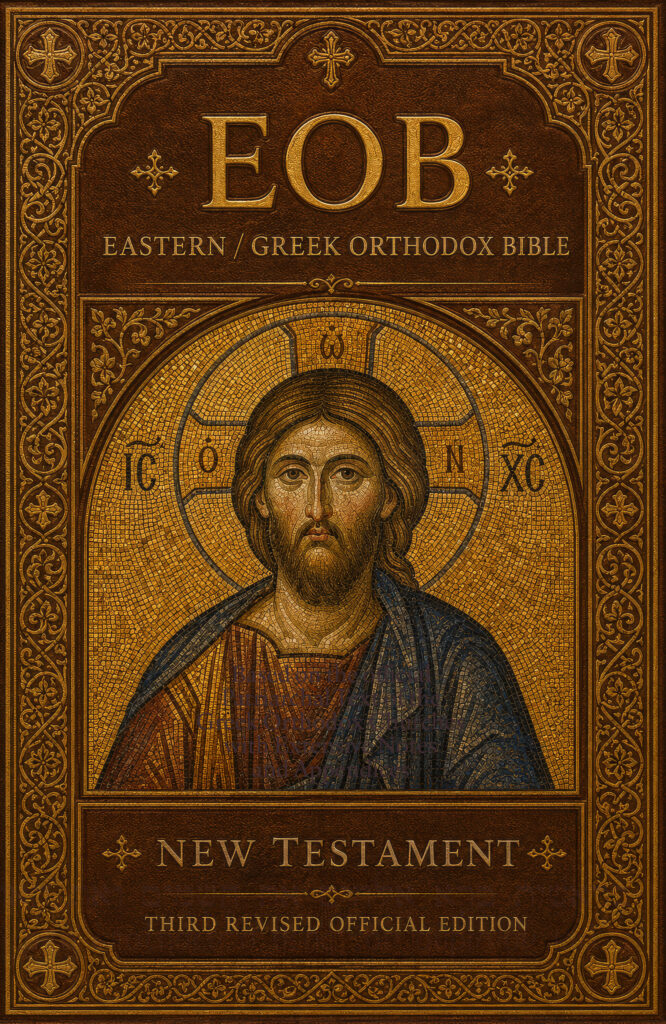
EOB: Official Site of the Eastern / Greek Orthodox Bible (Old and New Testament)

Genesis 5:30

EOB (Eastern / Greek Orthodox Bible):

After Lamech had Noah, he lived for five hundred ninety-five years and had more sons and daughters.

EOB Footnote:

The MT reads “five hundred ninety and five years” for Lamech’s remaining lifespan after fathering Noah, while the LXX reads “five hundred sixty-five years.” This numerical discrepancy (595 vs. 565) represents a difference of thirty years and reflects the well-known chronological variations between the Hebrew and Greek textual traditions in the Genesis 5 genealogy.

Other Translations:

KJV (King James Version):

And Lamech lived after he begat Noah five hundred ninety and five years, and begat sons and daughters.

WEB (World English Bible):

After Noah was five hundred years old, Lamech lived 595 years, and became the father of sons and daughters.

Benton LXX (Vaticanus):

And Lamech lived after he begot Noe, five hundred and sixty-five years, and begot sons and daughters.

Douai-Rheims (Vulgate):

And Lamech lived after he begot Noe, five hundred and ninety-five years, and begot sons and daughters.

Apostoliki Diakonia (LXX):

After Lamech had begotten Noah, he lived seven hundred and ninety-five years and begot sons and daughters.

YLT (Young Literal Translation )(MT):

After Noah was born, Lamech lived 595 years, and he had sons and daughters.

BBE (Bible in Basic English):

And after the birth of Noah, Lamech went on living for five hundred and ninety-five years, and had sons and daughters.

EOB COMMENTARY:

EOB Commentary:

Commentary on Genesis 5:30

This verse records that Lamech lived five hundred ninety-five years after begetting Noah and fathered other sons and daughters. While appearing to be merely genealogical data, this passage carries significance within the broader context of the antediluvian genealogy and its typological fulfillment.

Christological and Typological Significance

The genealogy of Genesis 5 serves as the sacred lineage through which the promise of Genesis 3:15 would ultimately be fulfilled. Lamech’s continued life after Noah’s birth and his fathering of additional children demonstrates the ongoing multiplication of the righteous line of Seth. The Church Fathers understood this genealogy as the preparation for the Incarnation, with each generation preserving the seed through which Christ would come. Saint Luke explicitly traces our Lord’s genealogy through this very line, connecting Jesus to Noah and through him to Lamech (Luke 3:36-37).

Patristic Interpretation

Saint John Chrysostom, in his Homilies on Genesis, notes that the genealogies demonstrate God’s providential care in preserving a faithful remnant even as humanity descended into corruption. The extended lifespans of the patriarchs allowed for the transmission of divine knowledge and the multiplication of the godly seed before the Flood would cleanse the earth.

Liturgical Connection

The genealogy of Christ is solemnly chanted during the Royal Hours of the Nativity, where the Church proclaims the entire lineage from Adam to Christ. This liturgical practice affirms that every generation mentioned in Genesis 5, including the years of Lamech recorded here, forms part of the sacred history culminating in the birth of the Savior. The faithful hear these names as witnesses to God’s patient working through human history.

Spiritual Reflection

The mention of additional sons and daughters reminds us that the biblical narrative focuses on the line of promise while acknowledging the broader human family. Orthodox spirituality recognizes that while God works through specific chosen vessels, His love extends to all humanity. The years recorded here, though seemingly mundane, represent real human lives lived in anticipation of salvation, teaching us that our own ordinary days participate in God’s greater plan of redemption.

Introduction to the book of Leviticus

The Book of Leviticus receives its English title from the Latin Vulgate, which is derived from the Greek Septuagint (LXX) title Leuitikon (Λευιτικόν), meaning “Levitical” or “pertaining to the Levites.”

Read More »

Introduction to the book of Exodus

The Book of Exodus receives its English title from the Greek Septuagint (LXX), where it is called Exodos (Ἔξοδος), meaning “departure” or “exit.” This name was chosen because the central

Read More »