Introduction to the book of Leviticus
The Book of Leviticus receives its English title from the Latin Vulgate, which is derived from the Greek Septuagint (LXX) title Leuitikon (Λευιτικόν), meaning “Levitical” or “pertaining to the Levites.”
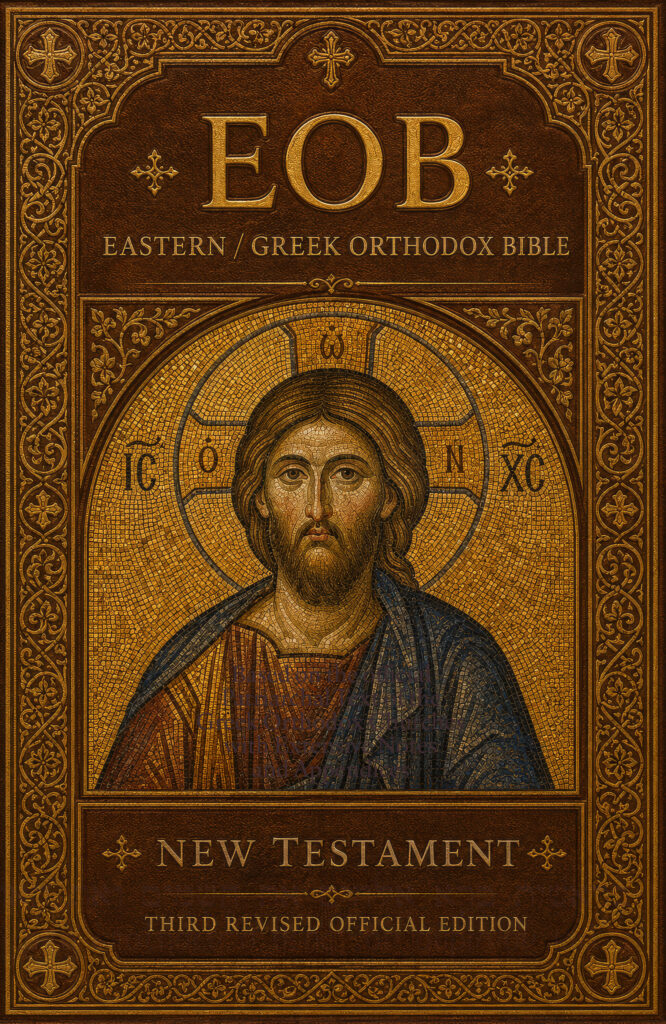
EOB: Official Site of the Eastern / Greek Orthodox Bible (Old and New Testament)
EOB (Eastern / Greek Orthodox Bible):
EOB Footnote:
KJV (King James Version):
WEB (World English Bible):
Benton LXX (Vaticanus):
Douai-Rheims (Vulgate):
Apostoliki Diakonia (LXX):
YLT (Young Literal Translation )(MT):
BBE (Bible in Basic English):
EOB Commentary:
Commentary on Genesis 5:32
The Genealogical Significance
This verse marks a pivotal transition in the Genesis narrative, introducing Noah’s three sons—Shem, Ham, and Japheth—who would become the progenitors of all post-diluvian humanity. The mention of Noah being five hundred years old when he begat these sons is noteworthy, as it represents the latest age of fatherhood recorded in the antediluvian genealogies, suggesting perhaps Noah’s particular righteousness in waiting or God’s providential timing in preparing the instruments of human preservation.
Christological and New Testament Connections
The genealogy of our Lord Jesus Christ in Luke’s Gospel traces the Savior’s lineage through Shem, establishing Christ’s connection to the covenant promises. Saint Paul’s declaration that in Christ there is neither Jew nor Greek finds its foundation here, as all nations descend from these three brothers, and all are called to salvation through the Second Adam. The Church Fathers saw in Noah a type of Christ—the righteous one through whom humanity is saved from destruction—and in his three sons, a prefiguration of the universal mission of the Gospel to all peoples.
Patristic Interpretation
Saint John Chrysostom observes that the Scripture names all three sons together to emphasize the unity of the human family that would emerge from the ark. Saint Augustine, in his City of God, extensively discusses how the descendants of these three sons represent the totality of human civilization, with Shem’s line carrying the promise of the Messiah. The Fathers consistently interpreted the three sons as representing the three-fold division of the ancient world and the universal scope of redemption.
Liturgical and Spiritual Themes
In Orthodox hymnography, particularly during the period of the Triodion, Noah and his family are commemorated as righteous ancestors who preserved the human race. The theme of eight souls being saved through water (referenced by Saint Peter) connects directly to baptismal theology—the ark becoming a type of the Church, and the waters of the flood prefiguring the waters of regeneration.
The Orthodox Church sees in this passage a reminder that God preserves a righteous remnant even in times of universal apostasy. Noah’s faithfulness in begetting children despite the corruption surrounding him speaks to the Christian calling to bring forth spiritual fruit regardless of the moral climate of one’s age. The naming of the three sons also reminds us that every human being, regardless of ethnic origin, shares common ancestry and is equally called to theosis—deification through union with Christ, the true Ark of salvation.
The Book of Leviticus receives its English title from the Latin Vulgate, which is derived from the Greek Septuagint (LXX) title Leuitikon (Λευιτικόν), meaning “Levitical” or “pertaining to the Levites.”

The Book of Exodus receives its English title from the Greek Septuagint (LXX), where it is called Exodos (Ἔξοδος), meaning “departure” or “exit.” This name was chosen because the central

I. Date and Authorship Holy Tradition of the Orthodox Church, affirmed by the Fathers and the liturgical usage of the Church from the earliest centuries, attributes the Book of Genesis

Does Hebrews 11 on the Maccabees Show Stronger Alignment with 4 Maccabees than 2 Maccabees? Hebrews 11 (the famous “Hall of Faith” chapter) does not explicitly mention the Maccabees by