Introduction to the book of Leviticus
The Book of Leviticus receives its English title from the Latin Vulgate, which is derived from the Greek Septuagint (LXX) title Leuitikon (Λευιτικόν), meaning “Levitical” or “pertaining to the Levites.”
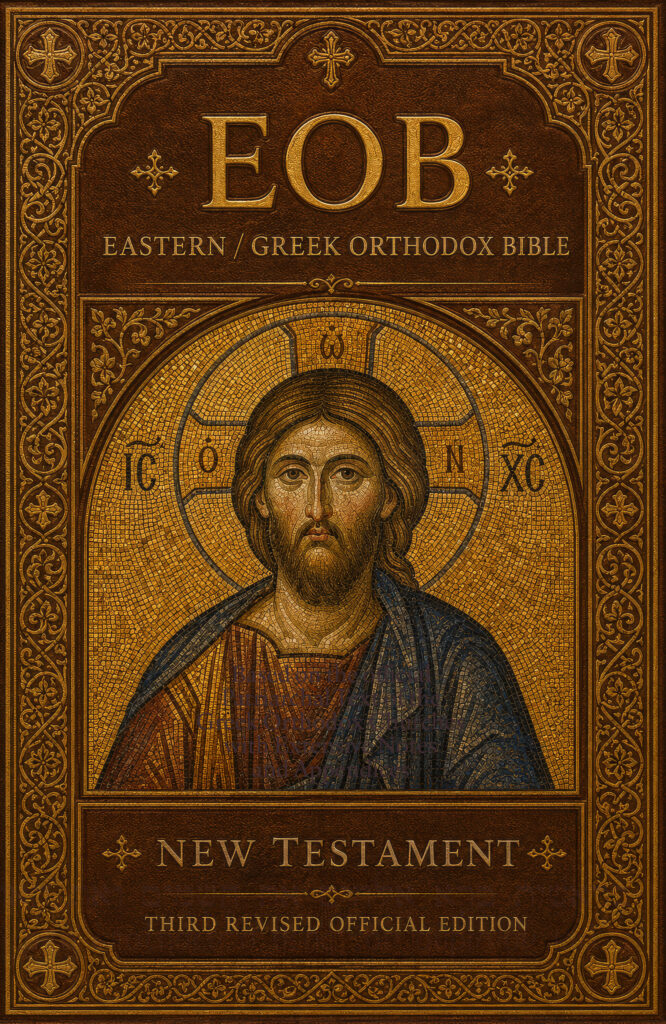
EOB: Official Site of the Eastern / Greek Orthodox Bible (Old and New Testament)
EOB (Eastern / Greek Orthodox Bible):
EOB Footnote:
KJV (King James Version):
WEB (World English Bible):
Benton LXX (Vaticanus):
Douai-Rheims (Vulgate):
Apostoliki Diakonia (LXX):
YLT (Young Literal Translation )(MT):
BBE (Bible in Basic English):
EOB Commentary:
Genesis 5:8 – Commentary
And all the days of Seth were nine hundred and twelve years: and he died.
The Death of Seth and the Shadow of Mortality
This verse records the passing of Seth, whose name means “appointed” or “substituted,” given by Eve because God appointed him as another seed in place of Abel whom Cain slew. Seth’s death, like that of his father Adam recorded just verses earlier, punctuates the genealogy with the sobering refrain “and he died” (kai apethanen). This repetition throughout Genesis 5 serves as a liturgical-like response reminding readers of the wages of sin introduced through the Fall.
Patristic Reflection: Saint John Chrysostom observes that the genealogies of Genesis, with their repeated notice of death, demonstrate that mortality became the universal inheritance of Adam’s descendants. The long lifespans of the antediluvian patriarchs, while remarkable, ultimately conclude with the same verdict. Chrysostom sees in this a divine pedagogy, teaching humanity that length of days cannot overcome the fundamental problem of death itself.
Typological Significance: Seth stands as a type of the faithful line through whom the promise of Genesis 3:15 would be preserved. His death, while marking the end of his earthly sojourn, does not terminate the sacred lineage. The seed continues through Enosh and onward, pointing toward the ultimate Seed, Christ, who would break the pattern entirely. Where Seth died after nine hundred and twelve years, Christ conquered death itself through His Resurrection.
Liturgical Connection: The Orthodox funeral service echoes the theology embedded in this verse. The repeated “and he died” of Genesis 5 finds its answer in the Paschal proclamation “Christ is risen from the dead, trampling down death by death.” The faithful departed, like Seth, fall asleep in hope of resurrection. The kontakion of the funeral service acknowledges that all flesh returns to dust, yet affirms the Christian hope that transcends the Adamic pattern.
Spiritual Application: For Orthodox spirituality, meditation on the deaths of the patriarchs cultivates remembrance of death (mneme thanatou), a practice commended by the Fathers as spiritually beneficial. Saint John Climacus teaches that remembrance of death purifies the soul and detaches it from worldly attachments. Seth’s nine centuries of life ultimately concluded as all earthly lives must, inviting believers to prepare their souls for eternity rather than presuming upon length of days.
The Book of Leviticus receives its English title from the Latin Vulgate, which is derived from the Greek Septuagint (LXX) title Leuitikon (Λευιτικόν), meaning “Levitical” or “pertaining to the Levites.”

The Book of Exodus receives its English title from the Greek Septuagint (LXX), where it is called Exodos (Ἔξοδος), meaning “departure” or “exit.” This name was chosen because the central

I. Date and Authorship Holy Tradition of the Orthodox Church, affirmed by the Fathers and the liturgical usage of the Church from the earliest centuries, attributes the Book of Genesis

Does Hebrews 11 on the Maccabees Show Stronger Alignment with 4 Maccabees than 2 Maccabees? Hebrews 11 (the famous “Hall of Faith” chapter) does not explicitly mention the Maccabees by