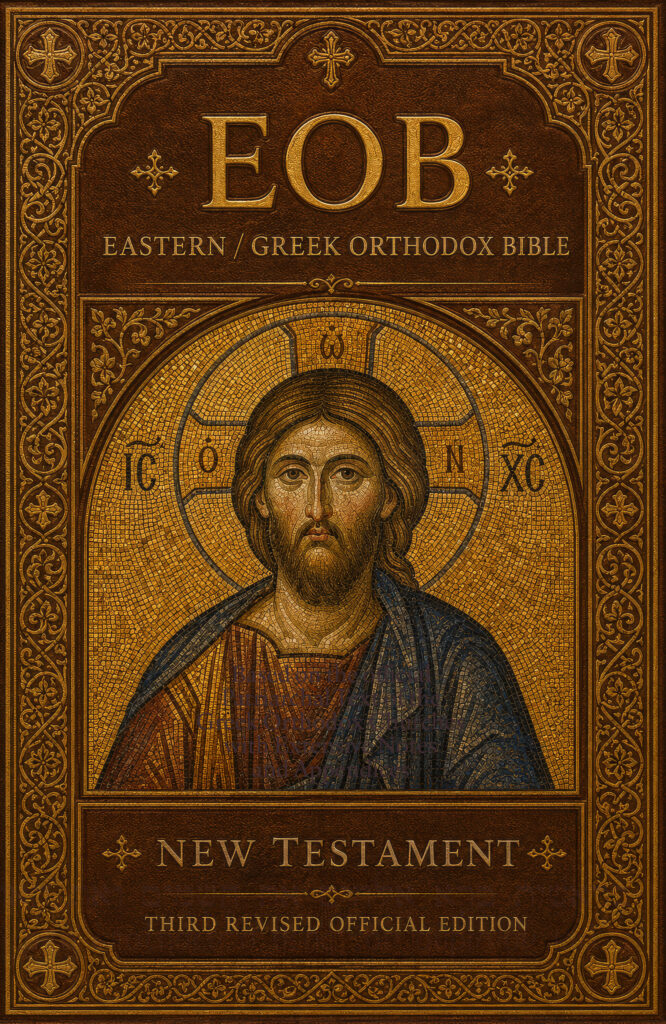
EOB: Official Site of the Eastern / Greek Orthodox Bible (Old and New Testament)

Genesis 6:14

EOB (Eastern / Greek Orthodox Bible):

Build a big boat out of gopher wood. Make rooms in it. Seal both the inside and outside with pitch.

EOB Footnote:

The MT includes the phrase “from inside and from outside” specifying that the ark should be covered with pitch on both surfaces; the LXX lacks this detail, stating only that the ark should be pitched with pitch. The MT uses “gopher wood” (a term of uncertain meaning, possibly cypress), while the LXX renders this as “squared timber.” The MT specifies “rooms” or “nests” shall be made in the ark; the LXX does not include this detail.

Other Translations:

KJV (King James Version):

Make thee an ark of gopher wood; rooms shalt thou make in the ark, and shalt pitch it within and without with pitch.

WEB (World English Bible):

“Make a ship of gopher wood. You shall make rooms in the ship, and shall seal it inside and outside with pitch.”

Benton LXX (Vaticanus):

Make therefore for thyself an ark of square timber; thou shalt make the ark in compartments, and thou shalt pitch it within and without with pitch.

Douai-Rheims (Vulgate):

Make thee an ark of timber planks: thou shalt make little rooms in the ark, and thou shalt pitch it within and without.

Apostoliki Diakonia (LXX):

Make yourself an ark of gopher wood; make rooms in the ark, and cover it inside and outside with pitch.

YLT (Young Literal Translation )(MT):

“Make for yourself an ark of gopher wood. Rooms you shall make in the ark, and you shall cover it inside and outside with pitch.”

BBE (Bible in Basic English):

Make for yourself an ark of gopher wood with rooms in it, and make it safe from the water inside and out.

EOB COMMENTARY:

EOB Commentary:

Commentary on Genesis 6:14

The Ark as Type of the Church and Salvation

This verse, in which God commands Noah to construct the ark from gopher wood and seal it with pitch, carries profound typological significance that the Church Fathers consistently recognized and developed in their writings.

The Ark as Image of the Church: Saint Cyprian of Carthage and other early Fathers saw in Noah’s ark a clear prefiguration of the Church. Just as the ark was the sole means of salvation from the waters of judgment, so the Church is understood as the vessel of salvation in Christ. Those within the ark were preserved; those outside perished. This typology reinforced the patristic teaching that salvation is found within the community of faith, united to Christ who is the true Ark.

Christ as the True Ark: The Fathers also perceived in the ark an image of Christ Himself. As the ark bore Noah and his family safely through the waters of death into new life, so Christ carries the faithful through the waters of baptism into resurrection life. The wood of the ark prefigures the wood of the Cross, the instrument through which salvation comes to humanity.

The Pitch and Sealing: The instruction to cover the ark with pitch inside and out (the Hebrew word kaphar is related to the word for atonement) suggested to patristic interpreters the sealing grace that protects believers. Some Fathers connected this to the seal of chrismation, by which the newly baptized are anointed and protected by the Holy Spirit.

Liturgical Connections: The account of Noah and the ark features prominently in the Orthodox liturgical tradition. The story appears among the Old Testament readings during the Vespers of Holy Saturday, connecting the salvation through water to baptismal regeneration. The hymnography of the Church frequently invokes Noah’s deliverance as a type of Christian salvation.

Spiritual Application: The construction of the ark according to divine specifications teaches the importance of obedience to God’s commands. Noah did not devise his own means of salvation but followed precisely what God revealed. This speaks to the Orthodox understanding of Holy Tradition as the faithful transmission of divine instruction for the building up of the Church.

The ark’s structure, with its multiple levels and single door, has been interpreted as representing the hierarchical yet unified nature of the Church, with Christ as the one entrance through whom all must pass to find salvation, as He Himself declared in the Gospel of John.

Introduction to the book of Leviticus

The Book of Leviticus receives its English title from the Latin Vulgate, which is derived from the Greek Septuagint (LXX) title Leuitikon (Λευιτικόν), meaning “Levitical” or “pertaining to the Levites.”

Read More »

Introduction to the book of Exodus

The Book of Exodus receives its English title from the Greek Septuagint (LXX), where it is called Exodos (Ἔξοδος), meaning “departure” or “exit.” This name was chosen because the central

Read More »