Commentary on Genesis 6:15
The Divine Blueprint and Its Christological Significance
The precise measurements given for the ark—three hundred cubits in length, fifty cubits in breadth, and thirty cubits in height—have captivated the attention of the Church Fathers, who perceived in these dimensions far more than mere construction specifications. These numbers constitute a divine revelation pointing toward the mystery of salvation in Christ.
St. Augustine observes that the proportions of the ark correspond remarkably to the proportions of the human body, which is approximately six times as long as it is wide and ten times as long as it is deep. This correspondence prefigures the Incarnation, wherein the Word became flesh and dwelt among us. The ark, built according to these human proportions, foreshadows the body of Christ, which becomes the true vessel of salvation for humanity.
The Ark as Type of the Church
The Fathers consistently interpret the ark as a type of the Church. St. Cyprian of Carthage emphasizes that just as there was no salvation outside the ark during the flood, so there is no salvation outside the Church. The specific dimensions underscore that the Church is not a human invention but a divine institution, built according to God’s own specifications and wisdom.
The three hundred cubits have been understood by some Fathers in relation to the Greek letter tau (T), which has the numerical value of three hundred and resembles the shape of the Cross. Thus the very length of the ark points toward the wood of the Cross, by which salvation comes to the world.
Liturgical and Spiritual Dimensions
In Orthodox hymnography, particularly during the period of the Triodion, the ark appears as an image of repentance and divine mercy. The careful construction according to exact measurements reminds the faithful that the spiritual life requires precision, obedience, and attention to divine commandments. One cannot build the vessel of salvation according to human preferences but must follow the pattern shown by God.
The thirty cubits of height have been associated with the age at which our Lord began His public ministry, suggesting that the ark in its totality encompasses the mystery of Christ’s saving work. The fifty cubits of breadth recall Pentecost, the fiftieth day, when the Holy Spirit descended upon the apostles and the Church was manifested to the world.
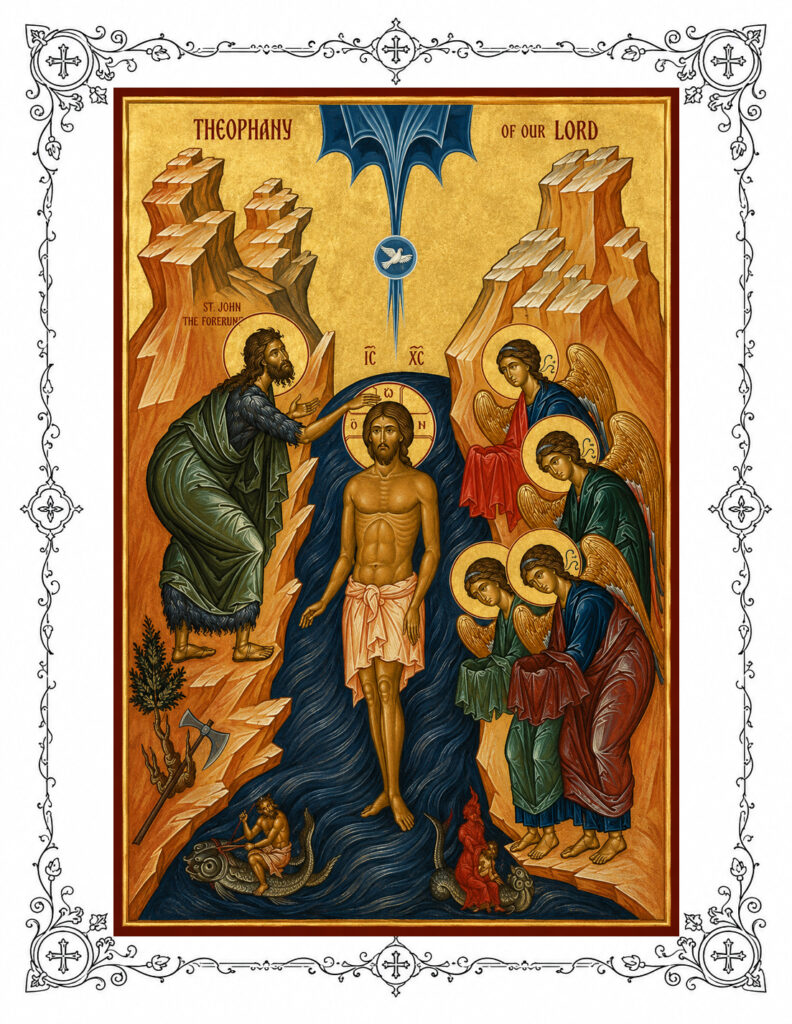
The faithful are called to enter this ark through baptism, wherein they pass through the waters of death into new life. The measurements remind us that salvation is particular and definite—not vague or arbitrary—but accomplished through the specific person of Jesus Christ, in His specific body, the Church, through the specific mysteries He has established.