EOB: Official Site of the Eastern / Greek Orthodox Bible (Old and New Testament)

Genesis 6:17

EOB (Eastern / Greek Orthodox Bible):

I will flood the earth and wipe out all living creatures, everything with the breath of life in it. All life on earth will be destroyed.

EOB Footnote:

The MT includes the phrase “behold, I” (hineni) before “am bringing,” which adds emphasis to God’s declaration. The LXX omits this emphatic particle, reading simply “I am bringing.” The MT specifies “the flood of waters” (mabbul mayim), whereas the LXX reads “the flood” (kataklusmon) without the additional specification “of waters.” In the phrase “to destroy all flesh in which is the breath of life,” the MT reads “spirit of life” (ruach chayyim) while the LXX uses a term meaning “breath of life” (pneuma zoes). Both convey the same essential meaning but with slightly different nuance.

Other Translations:

KJV (King James Version):

And, behold, I, even I, do bring a flood of waters upon the earth, to destroy all flesh, wherein is the breath of life, from under heaven; and every thing that is in the earth shall die.

WEB (World English Bible):

“Behold, I even I do bring the flood of waters on this earth, to destroy all flesh having the breath of life from under the sky. Everything that is in the earth will die.”

Benton LXX (Vaticanus):

And behold I bring a flood of water upon the earth, to destroy all flesh in which is the breath of life under heaven, and whatsoever things are upon the earth shall die.

Douai-Rheims (Vulgate):

And behold I will bring the waters of a great flood upon the earth, to destroy all flesh, wherein is the breath of life, under heaven. All things that are in the earth shall be consumed.

Apostoliki Diakonia (LXX):

I will bring floodwaters on the earth to destroy all life under the heavens, every creature that has the breath of life in it. Everything on earth will perish.

YLT (Young Literal Translation )(MT):

“And I, behold, I am bringing the flood of waters on the earth, to destroy all flesh in which is the breath of life from under the heavens; all that is on the earth shall die.”

BBE (Bible in Basic English):

For truly, I will send a great flow of waters over the earth, for the destruction from under heaven of all flesh in which is the breath of life; everything on the earth will come to an end.

EOB COMMENTARY:

EOB Commentary:

Commentary on Genesis 6:17

The Divine Announcement of the Flood

In this verse, God speaks directly to Noah, announcing His intention to bring the flood of waters upon the earth. The phrase “I, even I” (Hebrew: ani hineni) emphasizes the personal and deliberate nature of God’s action. This is not mere natural catastrophe but divine judgment proceeding from the Creator Himself.

Typological Significance for Christ and Baptism

The Fathers of the Church consistently read the flood narrative as a prefiguration of baptism and salvation through Christ. Saint Peter explicitly draws this connection, stating that baptism corresponds to the flood as an antitype (1 Peter 3:20-21). The waters that brought death to the corrupt world simultaneously bore up the ark of salvation. Saint Justin Martyr writes that the flood was a mystery of human salvation, with Noah and his family representing the remnant preserved through water and wood—the wood of the ark foreshadowing the wood of the Cross.

Saint Cyril of Jerusalem, in his Catechetical Lectures, teaches that just as the world was purified through water in Noah’s time, so the soul is cleansed through the waters of baptism. The destruction of “all flesh wherein is the breath of life” points toward the death of the old man in baptism, while those within the ark prefigure the new creation in Christ.

Liturgical Connections

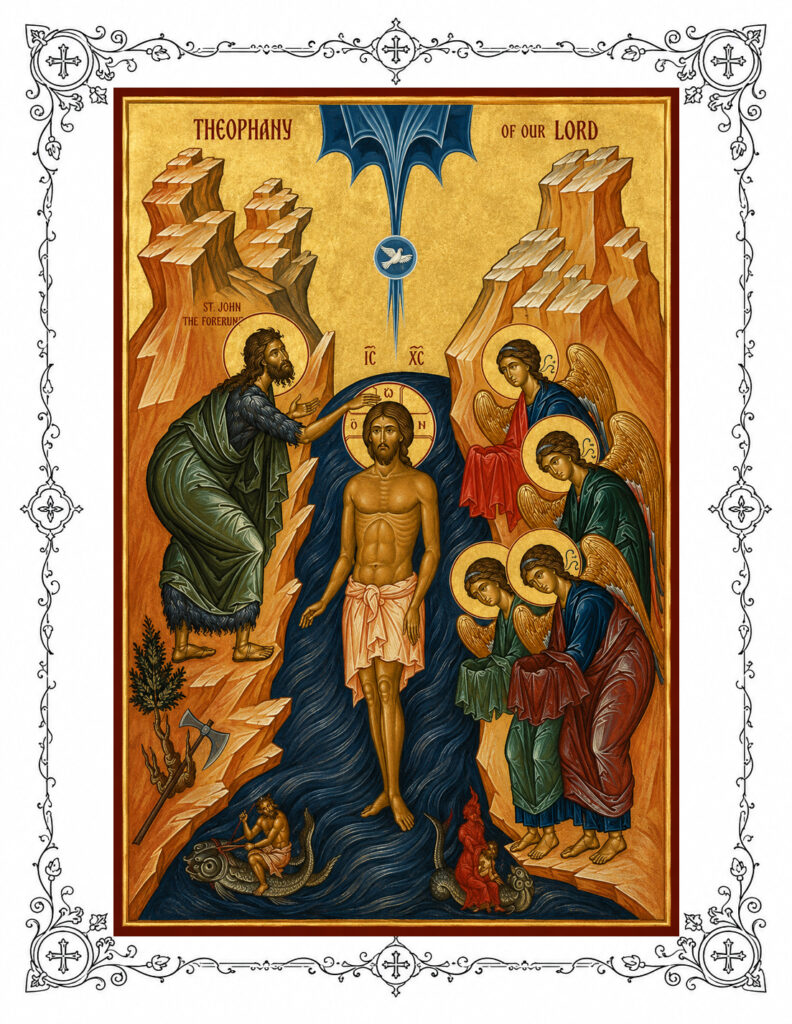
The Orthodox Church commemorates these themes prominently in the blessing of waters at Theophany. The Great Blessing prayers recall how God used water both for judgment and renewal throughout salvation history. The flood serves as a paradigm of divine mercy operating even within judgment, for God preserved a righteous remnant through whom His purposes would continue.

In the hymnography of Great Lent, Noah appears as a model of righteousness and obedience amid a corrupt generation. The Synaxarion readings during the pre-Lenten period recount the flood narrative, preparing the faithful for their own passage through the baptismal waters of repentance.

Spiritual Application

Saint John Chrysostom emphasizes that God’s announcement to Noah demonstrates divine patience and the opportunity for repentance. The construction of the ark over many years served as a visible warning to Noah’s contemporaries. This teaches the faithful that God’s judgments, though certain, are preceded by calls to conversion.

The breath of life (ruach chayyim) that would perish outside the ark reminds us that true life is found only within the vessel of salvation—understood by the Fathers as the Church, the ark of the new covenant, outside of which there is no salvation from the flood of sin and death.
Introduction to the book of Leviticus

The Book of Leviticus receives its English title from the Latin Vulgate, which is derived from the Greek Septuagint (LXX) title Leuitikon (Λευιτικόν), meaning “Levitical” or “pertaining to the Levites.”

Read More »

Introduction to the book of Exodus

The Book of Exodus receives its English title from the Greek Septuagint (LXX), where it is called Exodos (Ἔξοδος), meaning “departure” or “exit.” This name was chosen because the central

Read More »