Commentary on Genesis 6:20
The Divine Ordering of Creation
This verse reveals God’s providential care in preserving the fullness of creation through the ark. The threefold categorization of creatures—birds, cattle, and creeping things—echoes the ordering of creation in Genesis 1, demonstrating that the salvation wrought through Noah maintains the original divine intention for the created order. The phrase “according to their kind” (kata genos) emphasizes that God preserves the distinctiveness and diversity He established at creation.
Typological Significance for Christ and the Church
The Fathers consistently understood the ark as a type of the Church and of Christ Himself. Saint John Chrysostom observes that just as all kinds of creatures found salvation by entering the ark, so too people of every nation and condition find salvation by entering into Christ through baptism. The gathering of animals to Noah prefigures how Christ, the true Noah whose name means “rest,” draws all creation to Himself. As our Lord declared, “And I, if I am lifted up from the earth, will draw all peoples to Myself” (John 12:32).
Saint Ambrose of Milan sees in this gathering a foreshadowing of the Church’s catholicity—her universal embrace of all peoples. The animals coming “two by two” also suggests the missionary sending of the apostles in pairs, going forth to gather the nations into the ark of salvation.
Liturgical and Spiritual Dimensions
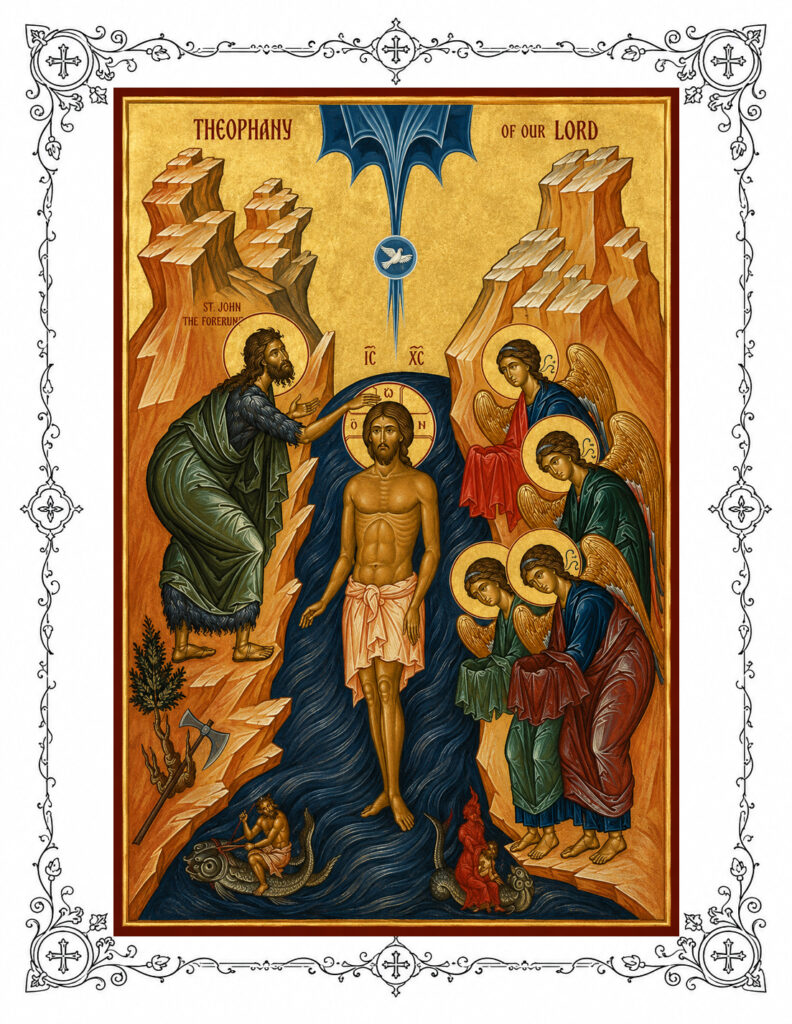
The Orthodox funeral service draws upon flood imagery, praying that the departed may find rest as the dove found rest upon the waters. The theme of preservation through divine command resonates throughout Orthodox liturgical life, particularly in the blessing of waters at Theophany, where the sanctification of creation is celebrated.
The voluntary coming of the animals to Noah demonstrates the harmony between creature and Creator that existed before the Fall and that is restored in the saints. Orthodox hagiography abounds with accounts of wild animals peacefully approaching holy men and women—Saint Seraphim of Sarov with his bear, Saint Gerasimos with his lion—manifesting the Edenic peace recovered through theosis.
The Cosmic Scope of Salvation
This verse reminds us that salvation in Orthodox understanding is never merely individual or even solely human. God’s covenant extends to all living creatures, anticipating Saint Paul’s teaching that all creation groans awaiting redemption (Romans 8:22). The ark preserves not souls alone but embodied creatures in their material fullness, pointing toward the resurrection of the body and the transfiguration of the entire cosmos in the age to come.