Introduction to the book of Leviticus
The Book of Leviticus receives its English title from the Latin Vulgate, which is derived from the Greek Septuagint (LXX) title Leuitikon (Λευιτικόν), meaning “Levitical” or “pertaining to the Levites.”
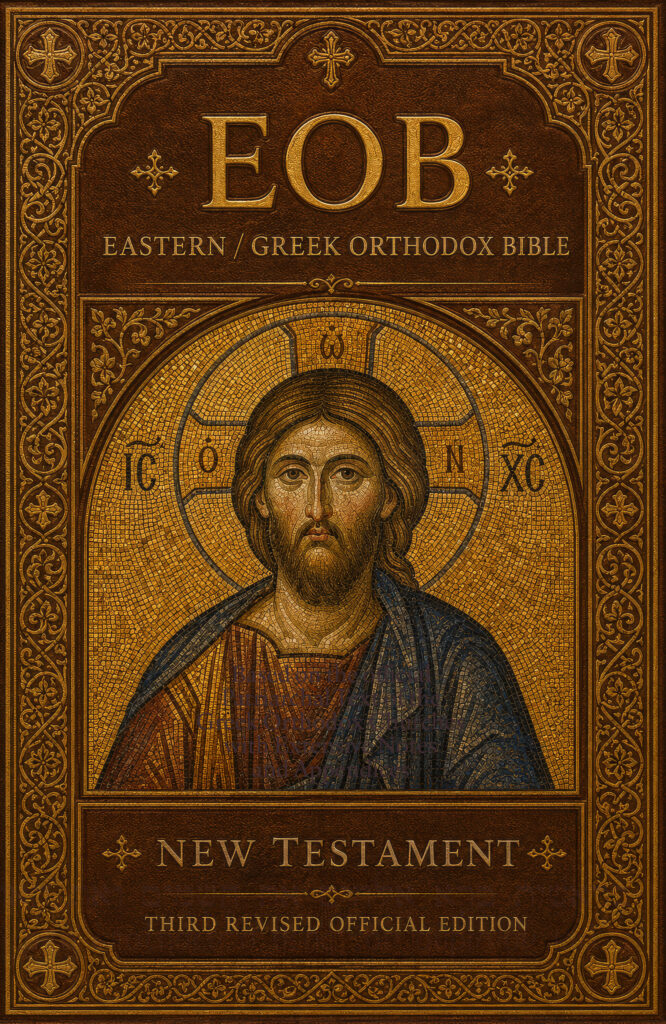
EOB: Official Site of the Eastern / Greek Orthodox Bible (Old and New Testament)
EOB (Eastern / Greek Orthodox Bible):
EOB Footnote:
KJV (King James Version):
WEB (World English Bible):
Benton LXX (Vaticanus):
Douai-Rheims (Vulgate):
Apostoliki Diakonia (LXX):
YLT (Young Literal Translation )(MT):
BBE (Bible in Basic English):
EOB Commentary:
GENESIS 6:21
Divine Providence and Preparation
This verse presents God’s instruction to Noah regarding the gathering of food for both his family and the animals aboard the ark. While seemingly a practical detail, the Fathers of the Church discerned profound spiritual meaning within this divine command.
Typological Significance
The ark itself serves as one of the most prominent types of the Church in patristic exegesis, and the provisions stored within it prefigure the spiritual nourishment that Christ provides to His faithful. Just as Noah was commanded to gather every kind of food that is eaten, so the Church gathers the faithful and sustains them with the Bread of Life. Saint Ambrose of Milan draws a connection between the provisions of the ark and the Eucharist, noting that as the ark preserved life through physical sustenance during the flood of judgment, so the Church preserves eternal life through the Body and Blood of Christ amidst the flood of sin that engulfs the world.
The Obedience of Faith
The command to gather food presupposes Noah’s trust in God’s word concerning events not yet seen. This anticipatory obedience mirrors the faith praised in Hebrews 11:7, where Noah is commended for acting in holy fear regarding things not yet visible. The gathering of provisions represents active cooperation with divine grace, a synergy between God’s saving initiative and human response that remains central to Orthodox soteriology.
Liturgical Resonance
The theme of divine provision finds expression in the Orthodox liturgical tradition, particularly in the prayers before Holy Communion where the faithful acknowledge Christ as the true food that nourishes unto eternal life. The Cherubic Hymn speaks of receiving the King of all, and the provisions of the ark prefigure this ultimate sustenance. Additionally, the blessing of food at Pascha and other feasts reflects the sanctification of material nourishment, recalling how God provided for Noah and his household.
Stewardship and Care for Creation
This verse also reveals God’s concern for all creatures, commanding Noah to provide for the animals as well. This divine solicitude for creation anticipates Christ’s teaching that not a single sparrow falls without the Father’s knowledge. The Orthodox understanding of humanity’s role as priest of creation finds early expression here, as Noah serves as steward and provider for the creatures entrusted to his care.
The verse thus weaves together themes of providence, faith, eucharistic prefigurement, and cosmic stewardship that resonate throughout the Orthodox theological and liturgical tradition.
The Book of Leviticus receives its English title from the Latin Vulgate, which is derived from the Greek Septuagint (LXX) title Leuitikon (Λευιτικόν), meaning “Levitical” or “pertaining to the Levites.”

The Book of Exodus receives its English title from the Greek Septuagint (LXX), where it is called Exodos (Ἔξοδος), meaning “departure” or “exit.” This name was chosen because the central

I. Date and Authorship Holy Tradition of the Orthodox Church, affirmed by the Fathers and the liturgical usage of the Church from the earliest centuries, attributes the Book of Genesis

Does Hebrews 11 on the Maccabees Show Stronger Alignment with 4 Maccabees than 2 Maccabees? Hebrews 11 (the famous “Hall of Faith” chapter) does not explicitly mention the Maccabees by