Commentary on Genesis 7:13
The Entrance into the Ark as Prefiguration of Baptism and Salvation
This verse marks the precise moment of salvation for Noah’s family—the very day they entered the ark. The specificity of “in the selfsame day” (en te hemera taute) emphasizes the decisive nature of divine deliverance. The Church Fathers consistently understood this passage as a profound type of baptism and the Church.
Saint Peter himself establishes the typological connection when he writes that baptism, “which corresponds to this, now saves you” (1 Peter 3:20-21). The eight souls saved through water become the paradigm for Christian baptism, where believers pass through the waters of death into new life. Saint Cyprian of Carthage explicitly states that as no one outside the ark was saved from the flood, so no one outside the Church can be saved—a principle that shaped Orthodox ecclesiology.
The naming of Noah’s three sons—Shem, Ham, and Japheth—carries theological weight. Patristic tradition sees in these three the ancestors of all nations who would eventually be gathered into the Church. Saint Augustine notes that the blessing and curse upon these sons prefigures the division among humanity in response to the Gospel. The ark thus becomes the vessel carrying the seeds of all future humanity, just as the Church carries within herself the potential salvation of all peoples.
Christological Significance
Noah himself serves as a type of Christ. As Noah led his family into salvation, so Christ leads the faithful into eternal life. The ark, constructed according to divine specifications, prefigures the Cross—the wood through which salvation comes. Some Fathers, including Saint Justin Martyr, note that the ark’s dimensions form a cross when viewed from certain angles, reinforcing this typology.
Liturgical Connections
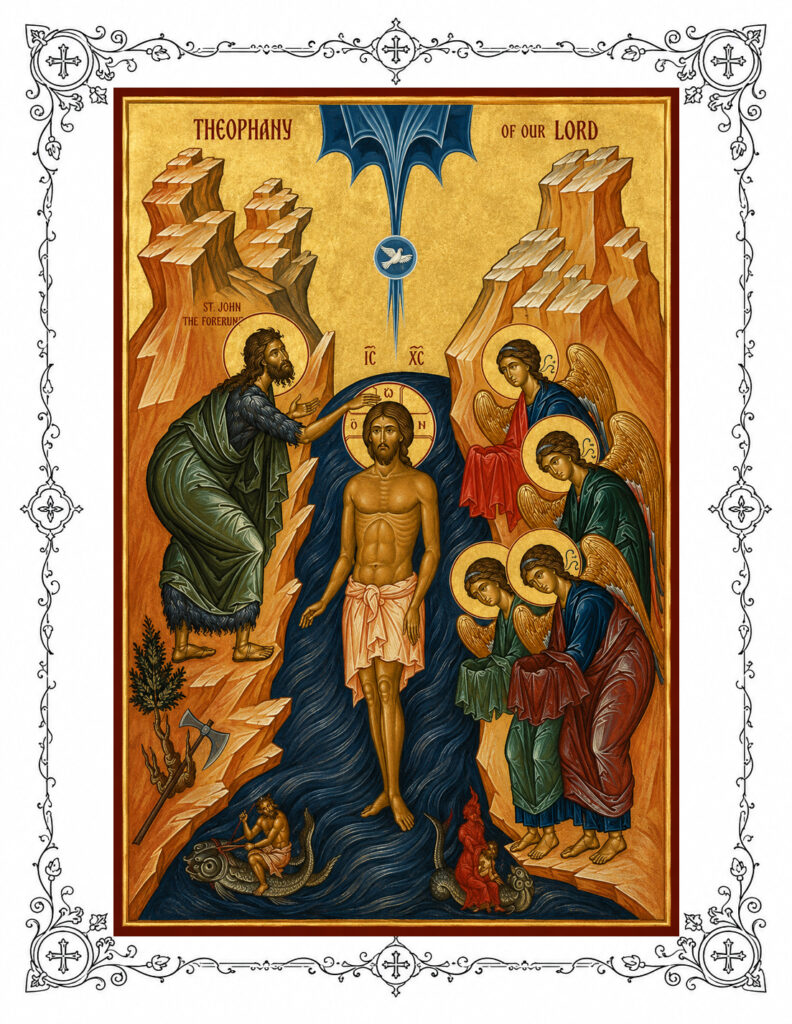
The Orthodox Church commemorates this saving event in the blessing of waters at Theophany, where the prayers recall how God saved Noah through water. The Paschal liturgy also echoes this theme, as the faithful pass through the baptismal waters into resurrection life, just as Noah’s family passed through the flood into a renewed creation.
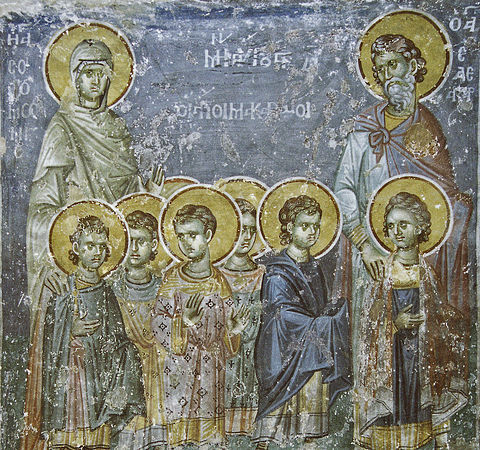
The mention of Noah’s wife and his sons’ wives reminds us that salvation, while personally appropriated, occurs within the context of family and community. The Orthodox understanding of theosis involves not isolated individuals but persons in communion—the domestic church entering together into the greater ark of Christ’s Body.
This verse thus stands as a hinge point in salvation history, connecting the old creation passing away with the new creation emerging, anticipating the greater passage from death to life accomplished in Christ’s Pascha.