Commentary on Genesis 7:23
The Divine Judgment and Salvation of the Remnant
This verse presents the stark reality of divine judgment while simultaneously revealing God’s mercy toward the righteous. The destruction of all living things upon the face of the earth stands as a sobering testimony to the consequences of humanity’s complete corruption, yet the preservation of Noah and those with him in the ark points forward to the greater salvation accomplished in Christ.
Typological Significance for Christ and Baptism
The Fathers of the Church consistently interpreted the Flood and Noah’s ark as prefigurations of baptism and the Church. Saint Peter himself establishes this connection, declaring that baptism corresponds to the waters through which Noah was saved (1 Peter 3:20-21). Just as only those within the ark were preserved from destruction, so too salvation is found within the Church, the ark of the New Covenant. Saint Cyprian of Carthage emphatically taught that outside the Church there is no salvation, drawing directly upon this typology.
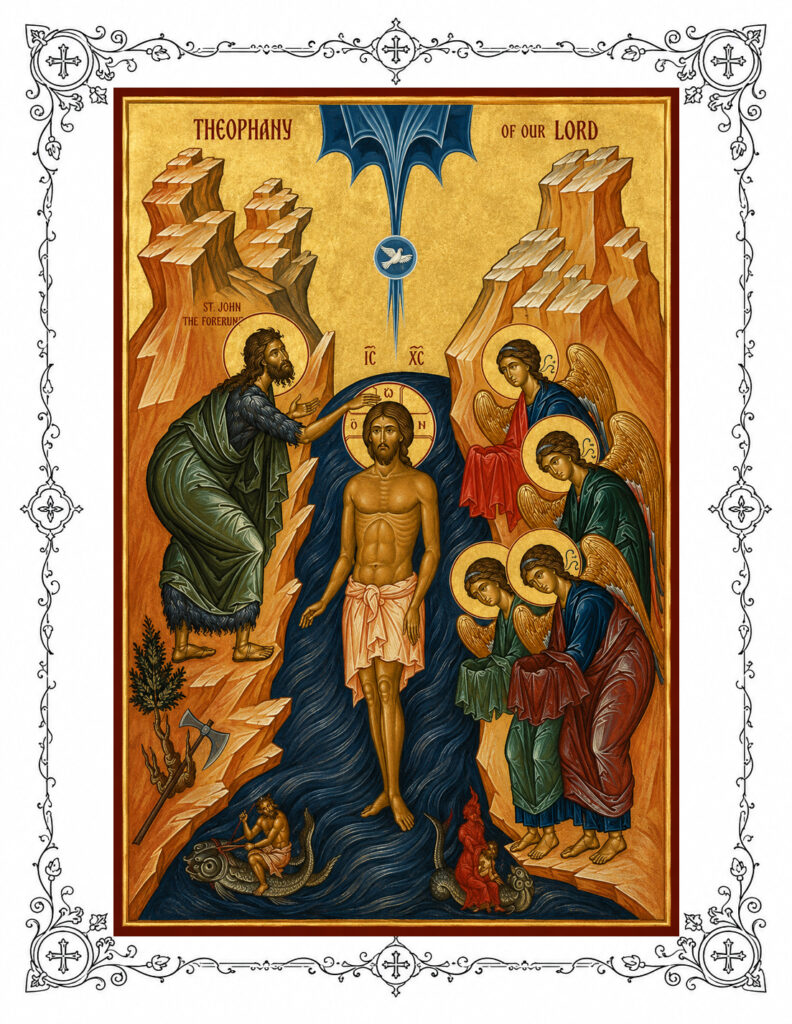
The waters that brought death to the sinful world simultaneously bore up the ark of salvation. In like manner, the baptismal waters signify both death to the old man of sin and resurrection to new life in Christ. Saint John Chrysostom observes that Noah emerged from the ark as from a baptismal font, entering into a renewed creation.
Liturgical Connections
The Orthodox Church commemorates these events in the readings appointed for Holy Saturday, when the faithful await the Resurrection of Christ. The Flood narrative is read as one of the fifteen Old Testament readings, emphasizing how God brings life out of death and salvation through water. The paschal character of Noah’s deliverance illuminates our understanding of Christ’s descent into Hades and His raising of the faithful dead.
The prayer at the blessing of baptismal waters recalls how God sanctified the nature of water, using it as an instrument of both judgment and salvation throughout sacred history.
Spiritual Application
For the Orthodox Christian, this verse serves as a perpetual reminder of the necessity of remaining within the saving ark of the Church, united to Christ through the sacramental life. The eight souls preserved in the ark correspond to the eighth day, the day of Resurrection and the age to come. Saint Justin Martyr notes that the number eight symbolizes the new creation inaugurated by Christ’s rising from the dead.
The complete destruction described here also prefigures the final judgment, urging the faithful toward repentance and vigilance. Yet the emphasis falls not upon destruction but upon divine mercy, for God remembered Noah, preserving a righteous remnant through whom His purposes of salvation would continue until their fulfillment in the Incarnate Word.