Genesis 7:9
The Obedience of Creation and the Mystery of Salvation
This verse presents a profound image of ordered obedience as the animals enter the ark “two by two, male and female, as God had commanded Noah.” The Fathers consistently saw in this passage a prefiguration of the Church and the cosmic scope of salvation that would be accomplished in Christ.
Typological Significance for Christ and the Church:
Saint John Chrysostom emphasizes that the animals came to Noah not by his own effort but by divine providence, demonstrating that salvation is ultimately God’s work. Just as the creatures entered the ark in pairs according to their kinds, so too does the Church gather humanity from every nation and tongue into the one vessel of salvation. The ark itself, as Saint Justin Martyr and many subsequent Fathers taught, is a type of the Cross and of Baptism, through which believers pass from death to life.
The phrase “as God commanded Noah” carries particular weight. Noah’s faithful obedience stands as a model for all who would follow Christ. The animals entering in ordered pairs reflects the restoration of creation’s harmony under righteous human stewardship, anticipating the new creation inaugurated by Christ, the second Adam.
Liturgical and Spiritual Connections:
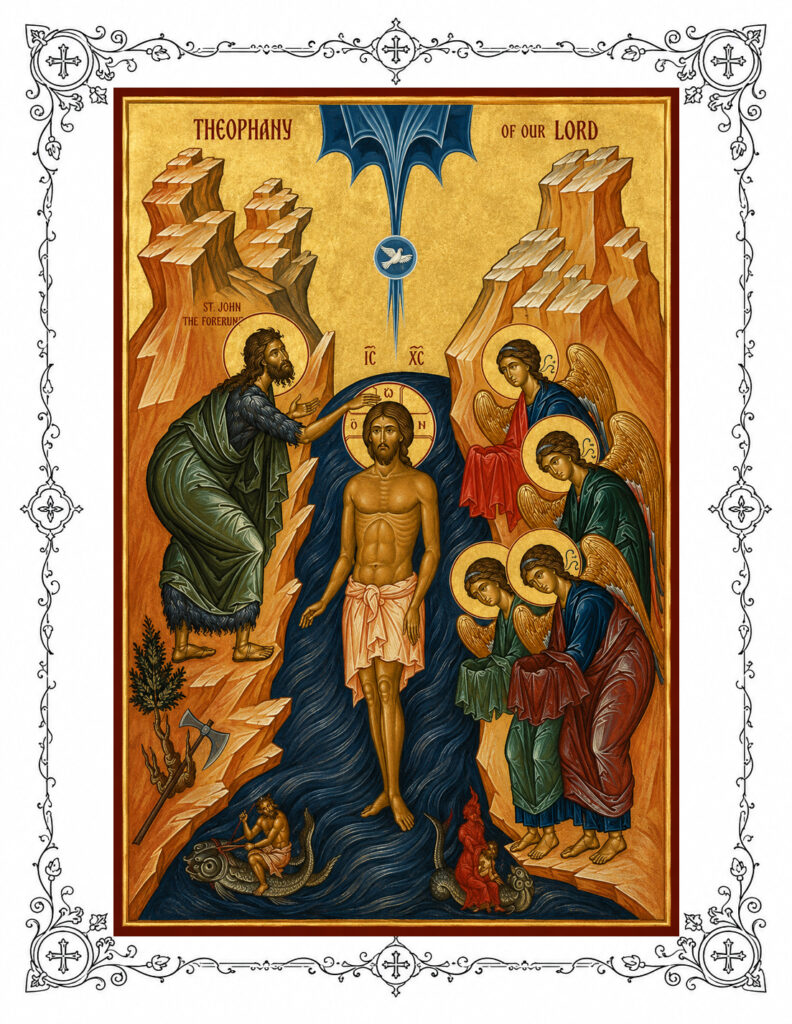
The Orthodox liturgical tradition draws upon the flood narrative during the blessing of waters at Theophany, where the prayers recall how God “saved Noah in the ark.” The entrance of the animals into the ark prefigures the gathering of the faithful into the baptismal waters, where they are preserved from the flood of sin and death.
Saint Ephrem the Syrian beautifully notes that the ark became a microcosm of peaceful creation, where natural enmities were suspended. This peace within the ark anticipates the eschatological peace of the Kingdom, where, as Isaiah prophesied, the wolf shall dwell with the lamb. The Church, like the ark, is called to be a place where divisions are overcome and creation finds its proper ordering under Christ.
Patristic Reflection:
Saint Ambrose of Milan saw in the male and female pairs entering together a preservation of the natural order established in creation, pointing toward the resurrection when the fullness of redeemed humanity would be gathered. The duality also reminded the Fathers of the union of soul and body, both of which find salvation in Christ.
The obedience of irrational creatures to God’s command through Noah shames rational humanity’s frequent disobedience, as Chrysostom pointedly observes. Yet this same passage offers hope: if God could orchestrate such willing cooperation from all creation for Noah’s sake, how much more will He accomplish through His beloved Son for the salvation of the world.