Introduction to the book of Leviticus
The Book of Leviticus receives its English title from the Latin Vulgate, which is derived from the Greek Septuagint (LXX) title Leuitikon (Λευιτικόν), meaning “Levitical” or “pertaining to the Levites.”
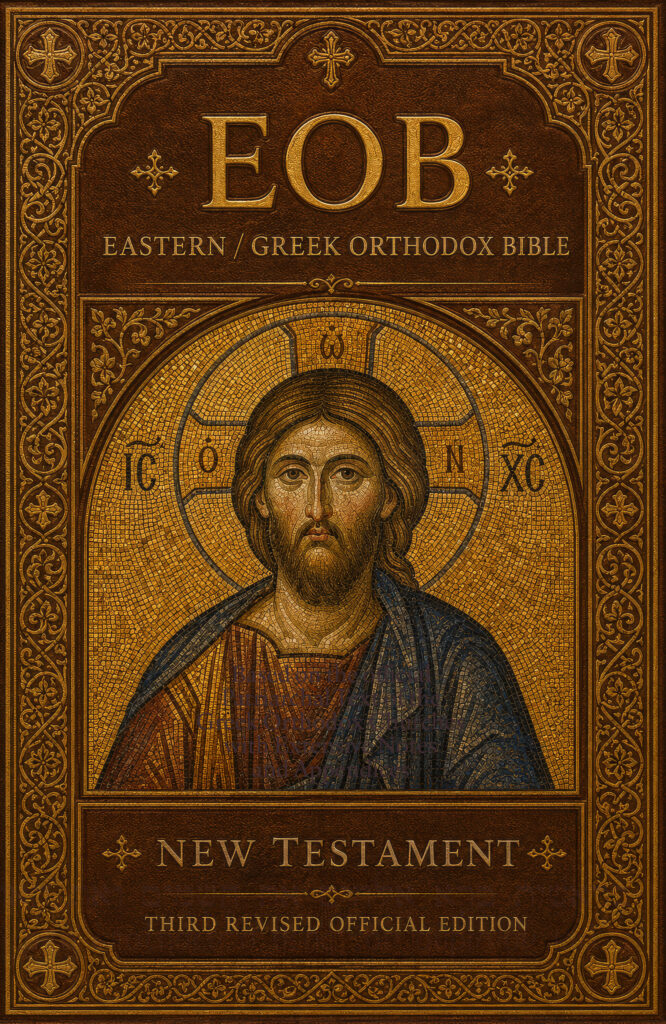
EOB: Official Site of the Eastern / Greek Orthodox Bible (Old and New Testament)
EOB (Eastern / Greek Orthodox Bible):
EOB Footnote:
KJV (King James Version):
WEB (World English Bible):
Benton LXX (Vaticanus):
Douai-Rheims (Vulgate):
Apostoliki Diakonia (LXX):
YLT (Young Literal Translation )(MT):
BBE (Bible in Basic English):
EOB Commentary:
Commentary on Genesis 8:18
The Departure from the Ark as New Creation
This verse marks the moment of emergence from the ark, presenting Noah and his family stepping forth onto a renewed earth. The Eastern Fathers consistently understood this passage as a type of resurrection and new beginning, carrying profound christological and baptismal significance.
Typological Significance for Christ and the Church
Saint John Chrysostom observes that just as Noah emerged from the ark to inherit a cleansed world, so Christ emerged from the tomb to inaugurate the new creation. The order of departure—Noah first, then his wife, then his sons and their wives—reflects the restoration of proper order after the chaos of sin. The family emerges as a reconstituted humanity, a new Adam with his household, prefiguring Christ as the New Adam who leads redeemed humanity out of the waters of death into resurrected life.
Saint Ephrem the Syrian notes that the ark resting and opening corresponds to the sealed tomb being opened. Noah’s emergence on dry ground after the flood waters receded typifies Christ’s victory over the waters of death and His emergence from Hades, bringing with Him the souls of the righteous.
Baptismal Theology
The Orthodox baptismal liturgy draws deeply from this imagery. The catechumen, like Noah, enters the waters of judgment and emerges into new life. The prayer of blessing over baptismal waters explicitly invokes the flood narrative, asking God who saved Noah through water to save the one being baptized. The emergence from the baptismal font mirrors Noah’s emergence from the ark—both represent passage through death into a transformed existence.
Liturgical Connections
This passage is read during the Vesperal Liturgy of Holy Saturday, where the Church explicitly connects the flood narrative to Christ’s descent into Hades and glorious Resurrection. The eight souls saved through water (referenced in 1 Peter 3:20) correspond to the eighth day—the day of Resurrection and the eschatological day beyond the seven days of creation.
Spiritual Application
For Orthodox spirituality, this verse speaks to the ascetical life. The faithful who enter the ark of the Church, enduring the flood of temptations and the death of the old self through repentance, will emerge transformed. Saint Cyril of Jerusalem teaches that we must remain in the ark of salvation until God Himself opens the door, just as Noah waited for divine command before departing. This patience and obedience characterize the Orthodox understanding of theosis—we cooperate with grace but ultimately depend on God’s initiative for our deliverance and transformation.
The Book of Leviticus receives its English title from the Latin Vulgate, which is derived from the Greek Septuagint (LXX) title Leuitikon (Λευιτικόν), meaning “Levitical” or “pertaining to the Levites.”

The Book of Exodus receives its English title from the Greek Septuagint (LXX), where it is called Exodos (Ἔξοδος), meaning “departure” or “exit.” This name was chosen because the central

I. Date and Authorship Holy Tradition of the Orthodox Church, affirmed by the Fathers and the liturgical usage of the Church from the earliest centuries, attributes the Book of Genesis

Does Hebrews 11 on the Maccabees Show Stronger Alignment with 4 Maccabees than 2 Maccabees? Hebrews 11 (the famous “Hall of Faith” chapter) does not explicitly mention the Maccabees by