Introduction to the book of Leviticus
The Book of Leviticus receives its English title from the Latin Vulgate, which is derived from the Greek Septuagint (LXX) title Leuitikon (Λευιτικόν), meaning “Levitical” or “pertaining to the Levites.”
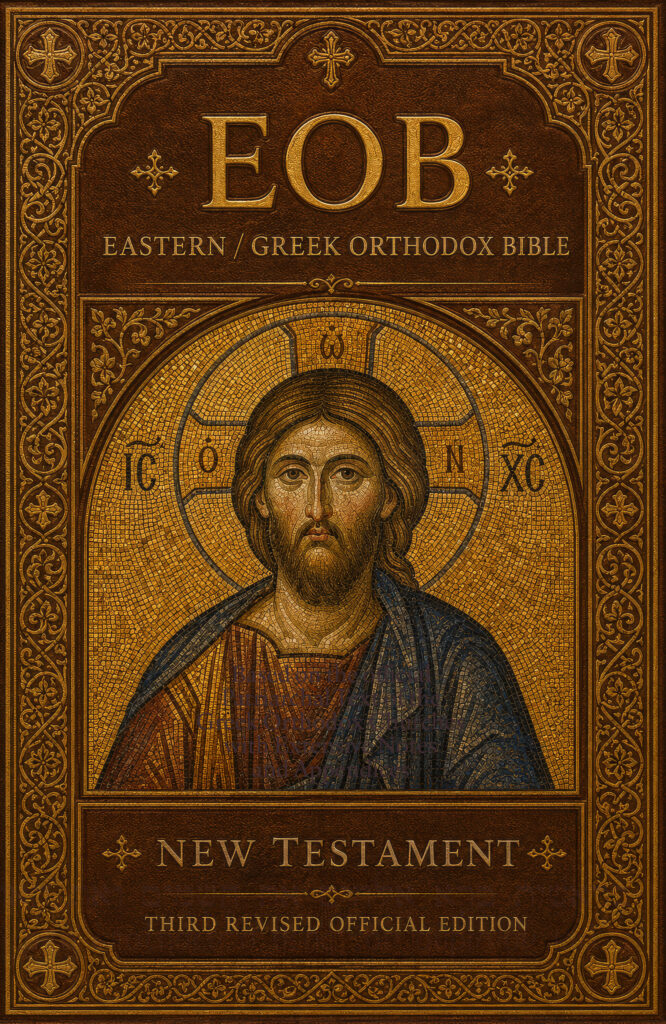
EOB: Official Site of the Eastern / Greek Orthodox Bible (Old and New Testament)
EOB (Eastern / Greek Orthodox Bible):
EOB Footnote:
KJV (King James Version):
WEB (World English Bible):
Benton LXX (Vaticanus):
Douai-Rheims (Vulgate):
Apostoliki Diakonia (LXX):
YLT (Young Literal Translation )(MT):
BBE (Bible in Basic English):
EOB Commentary:
Commentary on Genesis 9:18
This transitional verse introduces the three sons of Noah who emerged from the ark and from whom all the nations of the earth would descend. While appearing merely genealogical, this passage carries profound typological and theological significance within the Orthodox tradition.
The Ark as Type of the Church
The Fathers consistently interpreted Noah’s ark as a prefiguration of the Church, and the emergence of Noah’s sons represents the new humanity that proceeds from salvation through the waters. Saint John Chrysostom notes that just as the entire human race descended from these three men after the flood, so too the new humanity emerges from the waters of baptism into the life of the Church. The ark preserved eight souls through water, which Saint Peter explicitly connects to baptism (1 Peter 3:20-21), making this verse part of the broader typological framework essential to Orthodox sacramental theology.
Shem, Ham, and Japheth as Universal Humanity
The mention of these three sons anticipates the Table of Nations in Genesis 10 and establishes that all humanity shares common ancestry in Noah. This unity of the human race becomes crucial for understanding the universal scope of salvation in Christ. The Fathers saw in this threefold division a preparation for the gospel’s proclamation to all nations. Saint Ephrem the Syrian observed that through these three, God preserved the diversity of gifts while maintaining the unity of human nature.
The Particular Note Concerning Ham
The parenthetical identification of Ham as the father of Canaan is not incidental but prepares the reader for the narrative that follows. The Fathers understood this as Moses writing with prophetic awareness, connecting the immediate story to Israel’s later encounter with the Canaanites. This literary technique demonstrates the organic unity of Scripture and its ultimately Christological direction.
Liturgical Connections
This passage appears in the cycle of Old Testament readings during Great Lent, when the Church reads through Genesis. The post-flood narratives remind the faithful of God’s covenant faithfulness and the renewal of creation, themes that intensify as the Church journeys toward Pascha. The emergence from the ark into a cleansed world prefigures the resurrection and the new creation inaugurated in Christ.
Spiritual Application
For Orthodox spirituality, this verse reminds us that we who have passed through the waters of baptism are called to populate the earth with righteousness, becoming ancestors of faith for future generations. Just as Noah’s sons carried forward the human race, so baptized Christians carry forward the life of Christ in the world.
The Book of Leviticus receives its English title from the Latin Vulgate, which is derived from the Greek Septuagint (LXX) title Leuitikon (Λευιτικόν), meaning “Levitical” or “pertaining to the Levites.”

The Book of Exodus receives its English title from the Greek Septuagint (LXX), where it is called Exodos (Ἔξοδος), meaning “departure” or “exit.” This name was chosen because the central

I. Date and Authorship Holy Tradition of the Orthodox Church, affirmed by the Fathers and the liturgical usage of the Church from the earliest centuries, attributes the Book of Genesis

Does Hebrews 11 on the Maccabees Show Stronger Alignment with 4 Maccabees than 2 Maccabees? Hebrews 11 (the famous “Hall of Faith” chapter) does not explicitly mention the Maccabees by