Introduction to the book of Leviticus
The Book of Leviticus receives its English title from the Latin Vulgate, which is derived from the Greek Septuagint (LXX) title Leuitikon (Λευιτικόν), meaning “Levitical” or “pertaining to the Levites.”
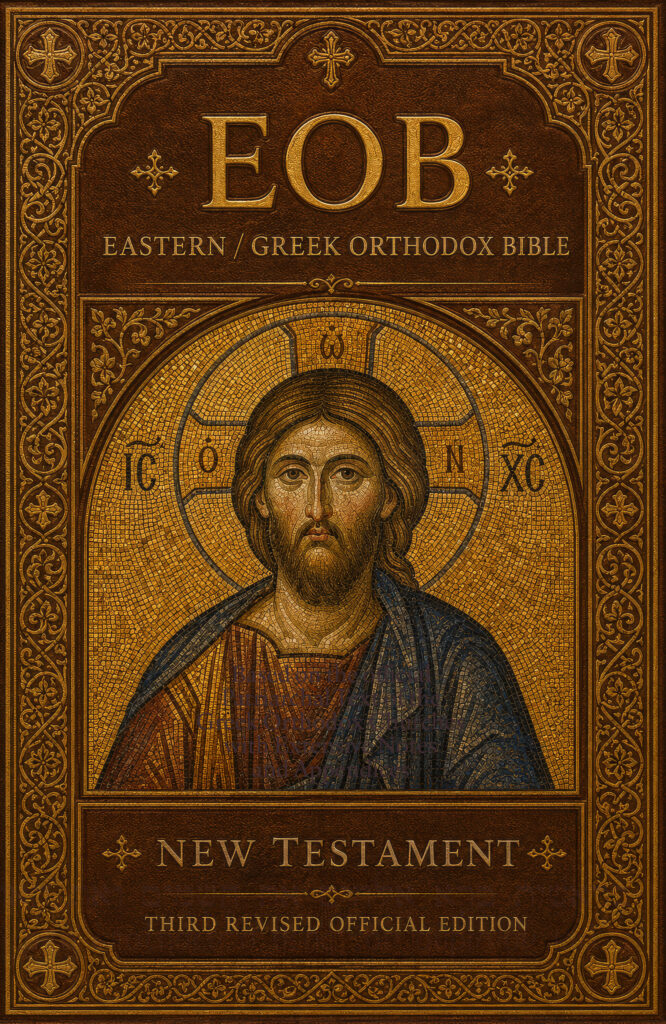
EOB: Official Site of the Eastern / Greek Orthodox Bible (Old and New Testament)
EOB (Eastern / Greek Orthodox Bible):
EOB Footnote:
KJV (King James Version):
WEB (World English Bible):
Benton LXX (Vaticanus):
Douai-Rheims (Vulgate):
Apostoliki Diakonia (LXX):
YLT (Young Literal Translation )(MT):
BBE (Bible in Basic English):
EOB Commentary:
Commentary on Genesis 9:20
Noah as Farmer and the Beginning of Viticulture
This verse marks a significant transition in the biblical narrative, presenting Noah in his post-diluvian role as a man of the soil who plants a vineyard. The Hebrew phrase “ish ha-adamah” (man of the ground) deliberately echoes Adam’s connection to the adamah from which he was formed, suggesting that Noah represents a new beginning for humanity while simultaneously inheriting the agricultural vocation given to the first man.
Typological Significance
The Fathers of the Church recognized in Noah’s planting of the vineyard a profound typological connection to Christ. Saint John Chrysostom notes that just as Noah cultivated the vine after the waters of judgment receded, so Christ, the true Vine (John 15:1), establishes His vineyard—the Church—after passing through the waters of death and resurrection. The vineyard becomes a recurring biblical image for God’s people, reaching its fulfillment in our Lord’s teaching about Himself as the Vine and His disciples as the branches.
Saint Ephrem the Syrian observes that Noah’s agricultural work demonstrates the restoration of the divine command to tend and keep the earth, showing that the flood did not abolish humanity’s stewardship but renewed it under the covenant of grace symbolized by the rainbow.
Liturgical and Spiritual Connections
The wine produced from Noah’s vineyard anticipates the Eucharistic mystery. Orthodox hymnography frequently draws connections between Old Testament wine and the precious Blood of Christ offered in the Divine Liturgy. The cultivation of the vineyard thus becomes a preparation in salvation history for the ultimate fruit of the vine—the cup of the New Covenant.
In the prayers of the Proskomedia, the preparation of the Eucharistic gifts, the Church acknowledges that all good things of the earth find their purpose in being offered back to God. Noah’s vineyard represents the first post-flood offering of human labor that would eventually yield the matter for the supreme Sacrament.
Ascetical Considerations
The verse also introduces a theme that will develop in the following verses regarding the proper use of God’s gifts. The Fathers consistently teach that wine itself is not evil—it is a blessing from God—but its misuse leads to shame and spiritual harm. This establishes an important principle in Orthodox spirituality: creation is good, but fallen humanity must exercise discernment and temperance. The monastic tradition particularly emphasizes this teaching, viewing Noah’s subsequent intoxication as a warning about vigilance even for the righteous.
The Book of Leviticus receives its English title from the Latin Vulgate, which is derived from the Greek Septuagint (LXX) title Leuitikon (Λευιτικόν), meaning “Levitical” or “pertaining to the Levites.”

The Book of Exodus receives its English title from the Greek Septuagint (LXX), where it is called Exodos (Ἔξοδος), meaning “departure” or “exit.” This name was chosen because the central

I. Date and Authorship Holy Tradition of the Orthodox Church, affirmed by the Fathers and the liturgical usage of the Church from the earliest centuries, attributes the Book of Genesis

Does Hebrews 11 on the Maccabees Show Stronger Alignment with 4 Maccabees than 2 Maccabees? Hebrews 11 (the famous “Hall of Faith” chapter) does not explicitly mention the Maccabees by