Introduction to the book of Leviticus
The Book of Leviticus receives its English title from the Latin Vulgate, which is derived from the Greek Septuagint (LXX) title Leuitikon (Λευιτικόν), meaning “Levitical” or “pertaining to the Levites.”
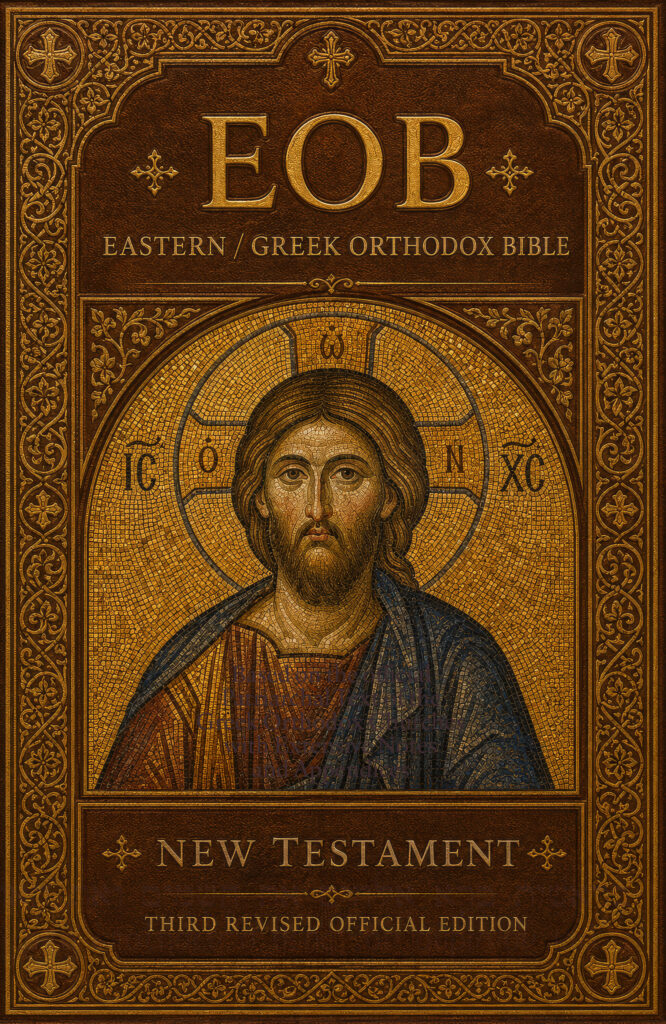
EOB: Official Site of the Eastern / Greek Orthodox Bible (Old and New Testament)
EOB (Eastern / Greek Orthodox Bible):
EOB Footnote:
KJV (King James Version):
WEB (World English Bible):
Benton LXX (Vaticanus):
Douai-Rheims (Vulgate):
Apostoliki Diakonia (LXX):
YLT (Young Literal Translation )(MT):
BBE (Bible in Basic English):
EOB Commentary:
Commentary on Genesis 9:22
The Sin of Ham and the Violation of Filial Piety
This verse recounts Ham’s transgression in looking upon his father Noah’s nakedness and then publicizing this shameful sight to his brothers. The Fathers of the Church understood this passage as far more than a simple act of seeing; it represents a fundamental violation of the honor due to parents and, by extension, to all sacred authority.
Patristic Interpretation
Saint John Chrysostom emphasizes that Ham’s sin was not merely accidental observation but deliberate disrespect. He notes that Ham “saw and published” the nakedness, making a spectacle of his father’s vulnerability rather than covering it in silence and love. Chrysostom contrasts this with the reverent response of Shem and Japheth, who walked backward to cover their father without gazing upon his shame. Saint Ephrem the Syrian similarly interprets Ham’s action as mockery, suggesting that Ham found pleasure in his father’s degradation rather than grief.
Typological Significance
The Church Fathers discerned in this narrative a prefigurement of those who would mock Christ in His Passion. Just as Ham exposed and ridiculed the patriarch who had preserved humanity through the flood, so too would mockers strip and deride the Savior who came to save humanity from the flood of sin and death. Noah’s nakedness, brought about through the fruit of the vine, mysteriously anticipates Christ’s nakedness on the Cross, where He who is the True Vine was exposed for the salvation of the world.
Conversely, Shem and Japheth prefigure those faithful ones who honor Christ even in His humiliation—the Theotokos, Saint John the Theologian, and the myrrh-bearing women who remained at the Cross and tenderly cared for His sacred body.
Spiritual Application
Orthodox spiritual tradition draws from this passage important lessons concerning the covering of sins. The proper Christian response to another’s weakness or fall is not exposure and mockery but compassionate concealment and restoration. This principle finds expression in the Mystery of Confession, where sins are revealed only to God through His priest, covered by divine mercy rather than broadcast for shame.
The commandment to honor father and mother, later codified in the Decalogue, finds its narrative foundation partly in this account. The Church teaches that such honor extends to spiritual fathers, bishops, and ultimately to God the Father Himself. Ham’s transgression thus serves as a perpetual warning against the spirit of irreverence that mocks sacred things and delights in the exposure of human frailty.
The Book of Leviticus receives its English title from the Latin Vulgate, which is derived from the Greek Septuagint (LXX) title Leuitikon (Λευιτικόν), meaning “Levitical” or “pertaining to the Levites.”

The Book of Exodus receives its English title from the Greek Septuagint (LXX), where it is called Exodos (Ἔξοδος), meaning “departure” or “exit.” This name was chosen because the central

I. Date and Authorship Holy Tradition of the Orthodox Church, affirmed by the Fathers and the liturgical usage of the Church from the earliest centuries, attributes the Book of Genesis

Does Hebrews 11 on the Maccabees Show Stronger Alignment with 4 Maccabees than 2 Maccabees? Hebrews 11 (the famous “Hall of Faith” chapter) does not explicitly mention the Maccabees by