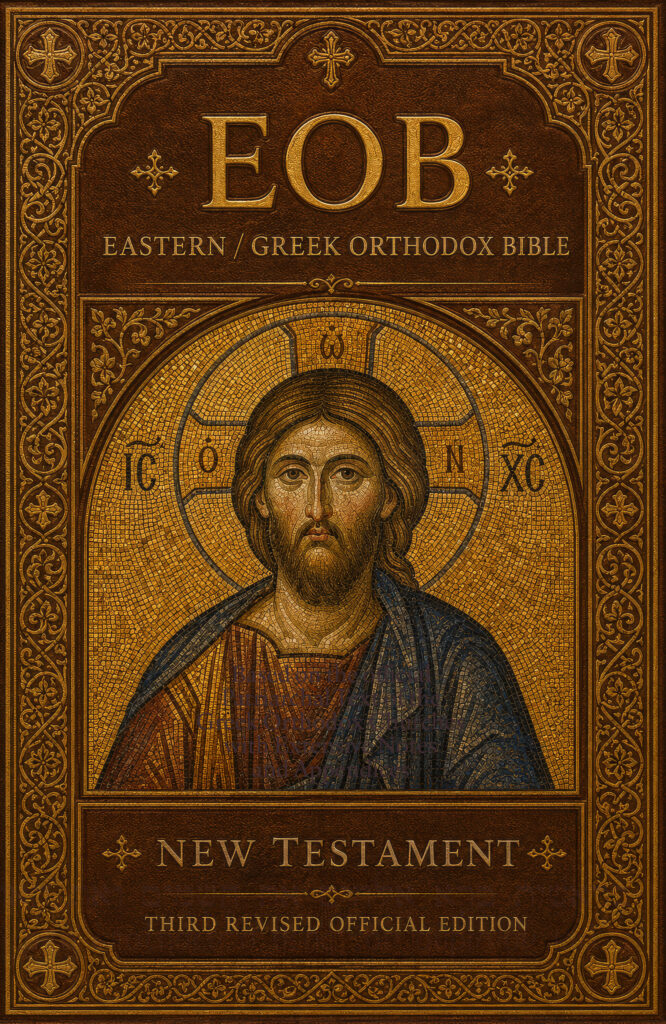
EOB: Official Site of the Eastern / Greek Orthodox Bible (Old and New Testament)

Genesis 9:23

EOB (Eastern / Greek Orthodox Bible):

Shem and Japheth grabbed a piece of clothing and put it on their shoulders. They walked in backward and covered their father’s naked body. They looked away so they wouldn’t see him naked.

EOB Footnote:

The MT includes the phrase “the nakedness of” before “their father” in the final clause, specifying that Shem and Japheth “did not see the nakedness of their father.” The LXX simply states they “did not see their father’s shame,” using a single noun rather than the construct phrase. The phrase “walking backward” renders the Greek literally; the Hebrew employs a different construction using the adverb “backward” with the verb of motion.

Other Translations:

KJV (King James Version):

And Shem and Japheth took a garment, and laid it upon both their shoulders, and went backward, and covered the nakedness of their father; and their faces were backward, and they saw not their father’s nakedness.

WEB (World English Bible):

Shem and Japheth took a garment, and laid it on both their shoulders, walked backward, and covered the nakedness of their father. Their faces were backward, and they didn’t see their father’s nakedness.

Benton LXX (Vaticanus):

And Sem and Japheth having taken a garment, put it upon both their shoulders, and went backwards, and covered the nakedness of their father, and their face was backward, and they saw not the nakedness of their father.

Douai-Rheims (Vulgate):

And Sem and Japheth put a cloak upon their shoulders, and going backward, covered the nakedness of their father: and their faces were turned away, and they saw not their father’s nakedness.

Apostoliki Diakonia (LXX):

Then Shem and Japheth took a garment, laid it on both their shoulders, and walked backward and covered their father’s nakedness. Their faces were turned away, and they did not see their father’s nakedness.

YLT (Young Literal Translation )(MT):

Shem and Japheth took a garment, laid it on both their shoulders, and walked backward and covered the nakedness of their father. Their faces were turned backward, and they did not see their father’s nakedness.

BBE (Bible in Basic English):

But Shem and Japheth took a robe, and put it on their backs, and walking backwards, with their faces turned away, put it over their father, so that they might not see him unclothed.

EOB COMMENTARY:

EOB Commentary:

Commentary on Genesis 9:23

The Covering of Shame and the Restoration of Honor

This verse presents Shem and Japheth as icons of filial piety and reverent love, walking backward to cover their father’s nakedness without gazing upon his shame. The Church Fathers consistently interpreted this act as prefiguring the work of Christ and the proper disposition of believers toward the mysteries of God.

Patristic Interpretation:
Saint Ambrose of Milan saw in this covering a type of the Church’s ministry, which veils the sins of the penitent rather than exposing them to ridicule. The backward movement of the sons signifies that we should not look upon the failings of our spiritual fathers with curiosity or judgment, but rather hasten to restore their dignity. Saint John Chrysostom emphasized that Shem and Japheth demonstrated the virtue their brother lacked, teaching us that when we encounter the weakness of others, our response reveals our own spiritual condition.

Christological Significance:
The garment (simlah) placed upon Noah’s shoulders finds its ultimate fulfillment in Christ, who clothes humanity’s nakedness with the robe of righteousness. Where Adam and Eve discovered their nakedness through sin and were clothed by God with garments of skin, here the sons of Noah participate in a similar act of merciful covering. This anticipates the parable of the Prodigal Son, where the father commands that the best robe be placed upon the returning child. Christ Himself becomes the garment of salvation, as Saint Paul writes: “As many as have been baptized into Christ have put on Christ.”

Liturgical Connections:
The Orthodox baptismal rite echoes this theme when the newly illumined is clothed in a white garment, symbolizing the restoration of the glory lost in Paradise. The prayer accompanying this vesting speaks of putting on Christ as a garment of incorruption. Furthermore, the reverent approach of Shem and Japheth, with faces turned away, mirrors the posture of the faithful before the Holy Mysteries, where we approach with fear of God, faith, and love, not presuming to gaze irreverently upon sacred things.

Spiritual Application:
The Orthodox spiritual tradition draws from this passage the teaching that love covers a multitude of sins. The Jesus Prayer and the practice of guarding the eyes find resonance here, as the sons deliberately chose not to see what would bring shame. This becomes a model for spiritual brotherhood within the Church, where we are called to bear one another’s burdens and restore the fallen in a spirit of gentleness, remembering our own vulnerability to temptation.

Introduction to the book of Leviticus

The Book of Leviticus receives its English title from the Latin Vulgate, which is derived from the Greek Septuagint (LXX) title Leuitikon (Λευιτικόν), meaning “Levitical” or “pertaining to the Levites.”

Read More »

Introduction to the book of Exodus

The Book of Exodus receives its English title from the Greek Septuagint (LXX), where it is called Exodos (Ἔξοδος), meaning “departure” or “exit.” This name was chosen because the central

Read More »