Introduction to the book of Leviticus
The Book of Leviticus receives its English title from the Latin Vulgate, which is derived from the Greek Septuagint (LXX) title Leuitikon (Λευιτικόν), meaning “Levitical” or “pertaining to the Levites.”
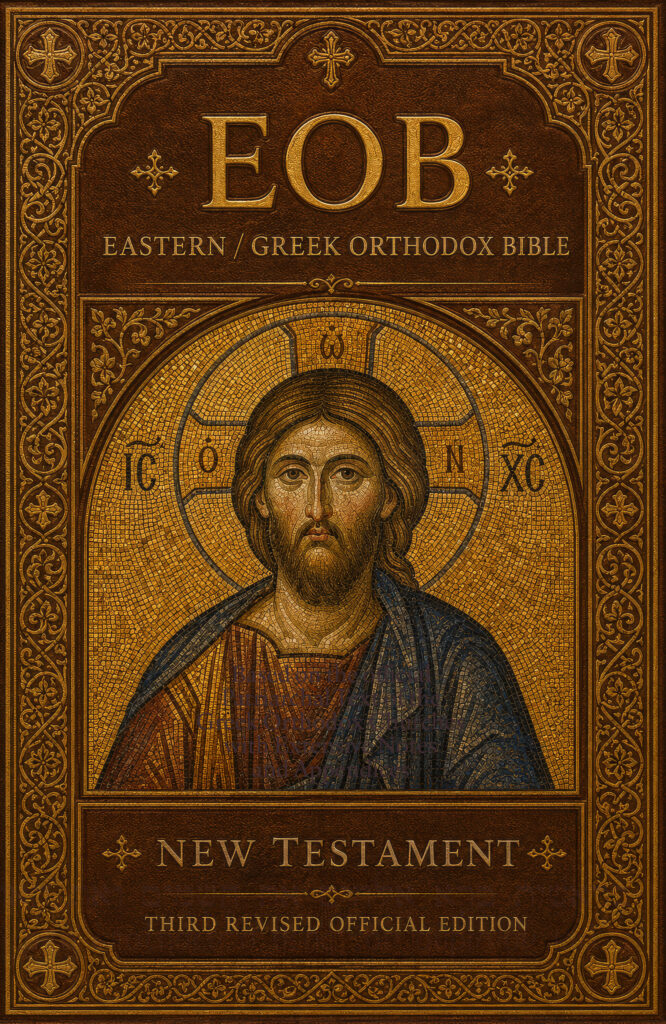
EOB: Official Site of the Eastern / Greek Orthodox Bible (Old and New Testament)
EOB (Eastern / Greek Orthodox Bible):
EOB Footnote:
KJV (King James Version):
WEB (World English Bible):
Benton LXX (Vaticanus):
Douai-Rheims (Vulgate):
Apostoliki Diakonia (LXX):
YLT (Young Literal Translation )(MT):
BBE (Bible in Basic English):
EOB Commentary:
Commentary on Genesis 9:28
This verse, noting that Noah lived three hundred and fifty years after the flood, serves as a transitional marker in the sacred narrative, yet it carries significance beyond mere chronology for Orthodox theological reflection.
The Longevity of the Righteous Patriarch
The extended lifespan of Noah after the deluge demonstrates God’s blessing upon the one whom Scripture calls “righteous” and “blameless in his generation” (Genesis 6:9). The Fathers understood these extended lifespans of the antediluvian and immediate post-diluvian patriarchs as signs of God’s providential care for humanity during its infancy, allowing the righteous to guide multiple generations toward the knowledge of the true God.
Saint John Chrysostom, in his Homilies on Genesis, reflects on the longevity of the patriarchs as serving a pedagogical purpose. Noah’s continued presence for three and a half centuries after the flood meant that the memory of divine judgment and mercy remained alive through living testimony. He stood as a perpetual witness to both the catastrophic consequences of sin and the saving power of God’s grace.
Typological Significance
Orthodox tradition consistently sees Noah as a type of Christ. Just as Noah preserved humanity through the waters of judgment and continued to guide the renewed creation, so Christ, having passed through death and resurrection, continues to shepherd His Church. The ark prefigures the Church, and Noah’s post-flood ministry anticipates Christ’s ongoing presence with His people until the end of the age.
The number of years—three hundred and fifty—while not carrying the same symbolic weight as other biblical numbers, nonetheless places Noah’s total lifespan at nine hundred and fifty years, approaching the millennium. Some patristic commentators saw in the near-millennial lifespans of the early patriarchs a foreshadowing of the eschatological rest, the “eighth day” of eternal life that awaits the faithful.
Liturgical Connections
In the Orthodox funeral service and memorial prayers, we invoke the patriarchs as examples of those who pleased God and now rest in His presence. Noah’s faithful endurance through the flood and his continued righteous life afterward provide a model for the Christian journey through the waters of baptism into a life of ongoing faithfulness.
The continuity of Noah’s life before and after the flood also speaks to the Orthodox understanding of theosis—the gradual transformation of the human person through grace. Noah did not simply survive the flood; he continued to live, to plant, and to participate in God’s renewed creation, just as the baptized Christian is called not merely to escape judgment but to grow into the fullness of life in Christ.
The Book of Leviticus receives its English title from the Latin Vulgate, which is derived from the Greek Septuagint (LXX) title Leuitikon (Λευιτικόν), meaning “Levitical” or “pertaining to the Levites.”

The Book of Exodus receives its English title from the Greek Septuagint (LXX), where it is called Exodos (Ἔξοδος), meaning “departure” or “exit.” This name was chosen because the central

I. Date and Authorship Holy Tradition of the Orthodox Church, affirmed by the Fathers and the liturgical usage of the Church from the earliest centuries, attributes the Book of Genesis

Does Hebrews 11 on the Maccabees Show Stronger Alignment with 4 Maccabees than 2 Maccabees? Hebrews 11 (the famous “Hall of Faith” chapter) does not explicitly mention the Maccabees by