EOB: Official Site of the Eastern / Greek Orthodox Bible (Old and New Testament)

Genesis 9:9

EOB (Eastern / Greek Orthodox Bible):

I am making a promise with you and with your children after you.

EOB Footnote:

The MT includes the phrase “with your seed after you” following “with you,” which the LXX omits. This addition specifies that the covenant extends to future generations and materially affects the scope of the covenant promise.

Other Translations:

KJV (King James Version):

And I, behold, I establish my covenant with you, and with your seed after you;

WEB (World English Bible):

“‘As for me, behold, I establish my covenant with you, and with your offspring after you,’”

Benton LXX (Vaticanus):

And behold, I establish my covenant with you, and with your seed after you,

Douai-Rheims (Vulgate):

“Behold I will establish my covenant with you, and with your seed after you:”

Apostoliki Diakonia (LXX):

Behold, I establish my covenant with you and with your descendants after you.

YLT (Young Literal Translation )(MT):

“‘And I, behold, I establish My covenant with you, and with your seed after you,’”

BBE (Bible in Basic English):

Now, truly, I will make my agreement with you and with your seed after you,

EOB COMMENTARY:

EOB Commentary:

Genesis 9:9 Commentary

The Divine Initiative in Covenant

This verse marks a pivotal moment in salvation history where God initiates a covenant not merely with Noah as an individual, but establishes a pattern of divine condescension that reaches its fullness in Christ. The phrase “I establish my covenant” (Hebrew: heqim beriti) emphasizes God’s sovereign initiative—humanity does not negotiate or earn this covenant but receives it as pure gift. This theological reality prefigures the New Covenant, where God in Christ acts unilaterally to save fallen humanity.

Typological Significance

The Fathers consistently read Noah as a type of Christ. Saint John Chrysostom observes that just as Noah became the father of a renewed humanity after the flood, so Christ becomes the new Adam, the head of regenerated humanity through baptismal waters. The covenant established here with Noah and his descendants anticipates the universal scope of salvation in Christ, who comes not for one nation alone but for all peoples.

Saint Cyril of Alexandria notes that the words “with you and your descendants” point toward the inclusive nature of God’s salvific will. The covenant extends beyond the immediate recipients to embrace future generations—a pattern fulfilled when Christ establishes the New Covenant in His blood for the remission of sins for many.

Liturgical Connections

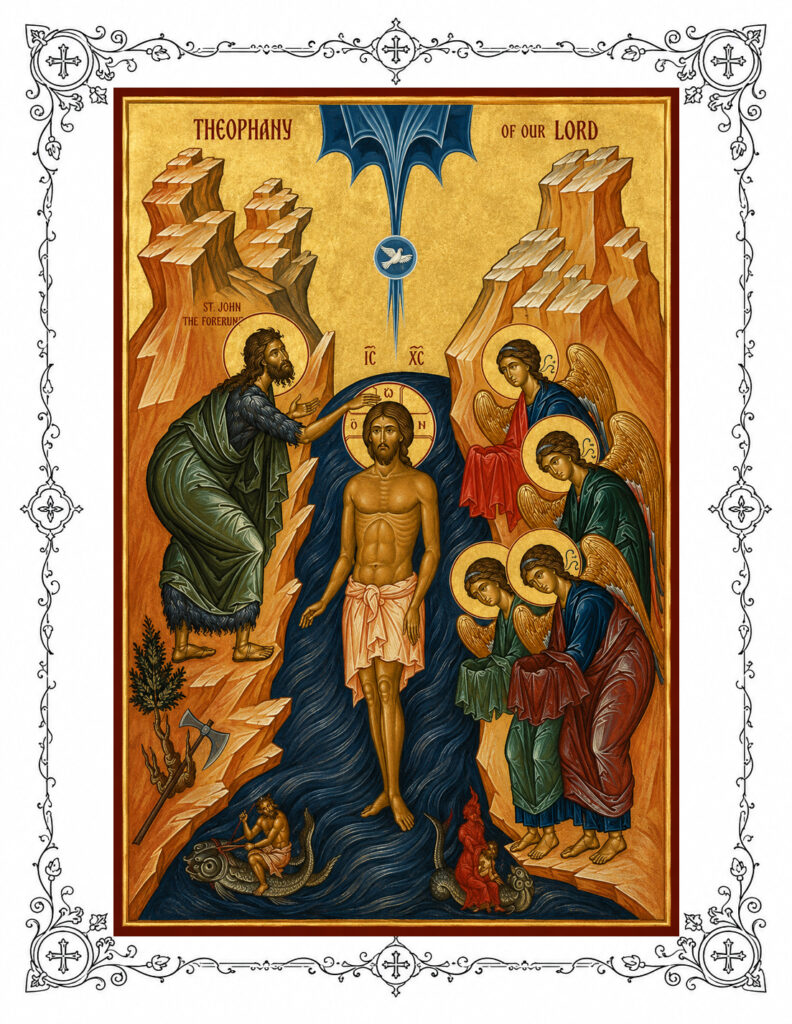
This passage finds resonance in the Orthodox baptismal liturgy, where the flood waters are remembered as both judgment and salvation. The prayer of blessing over baptismal waters recalls how God saved Noah through water, establishing this as a type of the baptismal mystery. The covenant with Noah thus becomes a lens through which the Church understands her own sacramental life.

During Great Lent, the reading of Genesis in the liturgical cycle brings this covenant narrative before the faithful as preparation for Pascha. The Church invites her children to see in Noah’s deliverance a foreshadowing of Christ’s victory over death and the new creation inaugurated through His resurrection.

Theological Reflection

The unconditional nature of this covenant reveals something essential about God’s character—His faithfulness does not depend on human merit. Orthodox theology emphasizes that God’s love precedes human response, creating the possibility for that response. This verse thus grounds the Orthodox understanding of grace as divine initiative that enables human cooperation (synergeia) rather than replacing it.

The covenant with Noah also establishes the sanctity of creation itself, preparing for the Orthodox vision of cosmic redemption where all creation participates in the transfiguration accomplished in Christ.

Introduction to the book of Leviticus

The Book of Leviticus receives its English title from the Latin Vulgate, which is derived from the Greek Septuagint (LXX) title Leuitikon (Λευιτικόν), meaning “Levitical” or “pertaining to the Levites.”

Read More »

Introduction to the book of Exodus

The Book of Exodus receives its English title from the Greek Septuagint (LXX), where it is called Exodos (Ἔξοδος), meaning “departure” or “exit.” This name was chosen because the central

Read More »