Introduction to the book of Deuteronomy
I. Title and place in the canon The English title comes from the Greek Deuteronomion, “second law.” The name comes from 17:18, where the king is to write for himself
EOB: Official Site of the Eastern / Greek Orthodox Bible (Old and New Testament)
EOB (Eastern / Greek Orthodox Bible):
EOB Footnote:
KJV (King James Version):
WEB (World English Bible):
Benton LXX (Vaticanus):
Douai-Rheims (Vulgate):
Apostoliki Diakonia (LXX):
YLT (Young Literal Translation )(MT):
BBE (Bible in Basic English):
EOB Commentary:
Commentary on Genesis 9:19
This verse serves as a pivotal declaration of human unity, affirming that all peoples of the earth descend from the three sons of Noah: Shem, Ham, and Japheth. For Orthodox theology, this passage carries profound significance both anthropologically and soteriologically.
The Universal Scope of Salvation: The spreading of humanity from these three brothers establishes the foundation for understanding the universal mission of the Church. When Christ commands His apostles to “make disciples of all nations” (Matthew 28:19), this commission reaches back to Genesis 9:19, encompassing every branch of Noah’s descendants. The Table of Nations that follows in Genesis 10 demonstrates that no people group falls outside God’s providential care or redemptive purpose.
Patristic Interpretation: Saint John Chrysostom emphasizes that this verse reveals God’s remarkable economy in preserving humanity through a single family, thereby maintaining the unity of the human race even after the catastrophic judgment of the Flood. He sees in this a prefiguration of how God would later work through one Man, Christ, to restore all humanity. Saint Ephrem the Syrian similarly notes that just as the whole earth was populated from these three, so the whole Church would be gathered from every nation into one Body.
Typological Significance: The Fathers often read the three sons as representing the threefold division of humanity that would eventually be united in Christ. Some patristic commentators see in Japheth’s blessing (verse 27) a prophecy of the Gentiles entering into the tents of Shem, fulfilled when the nations received the Gospel that came through Israel.
Liturgical Connections: In the Orthodox funeral service and memorial prayers, we acknowledge our common descent and common mortality inherited from our first parents and passed through Noah’s family. The unity of the human race in both death and resurrection hope finds its roots in passages such as this. Additionally, the Pentecost narrative in Acts 2, where people from every nation hear the Gospel in their own tongues, represents the reversal of Babel and the fulfillment of the promise implicit in Genesis 9:19—that all the scattered descendants of Noah would be gathered into one faith.
Orthodox Anthropology: This verse supports the Orthodox teaching that all human beings share a common nature (physis) and dignity, created in God’s image. There is no theological basis for viewing any ethnic group as ontologically superior or inferior, for all descend equally from Noah and ultimately from Adam. This understanding undergirds the Orthodox commitment to the catholicity of the Church, which transcends all ethnic and national boundaries while honoring legitimate cultural diversity within the one Body of Christ.
I. Title and place in the canon The English title comes from the Greek Deuteronomion, “second law.” The name comes from 17:18, where the king is to write for himself
I. Title and place in the canon The English title comes from the Greek Arithmoi, “Numbers,” after the two censuses of the people that open its first and second halves
By Fr Laurent Cleenewerck, EOB Editor In 2021, Fr. John Whiteford published on his blog a substantial review of the EOB New Testament (Newrome Press portable edition). The review deserves
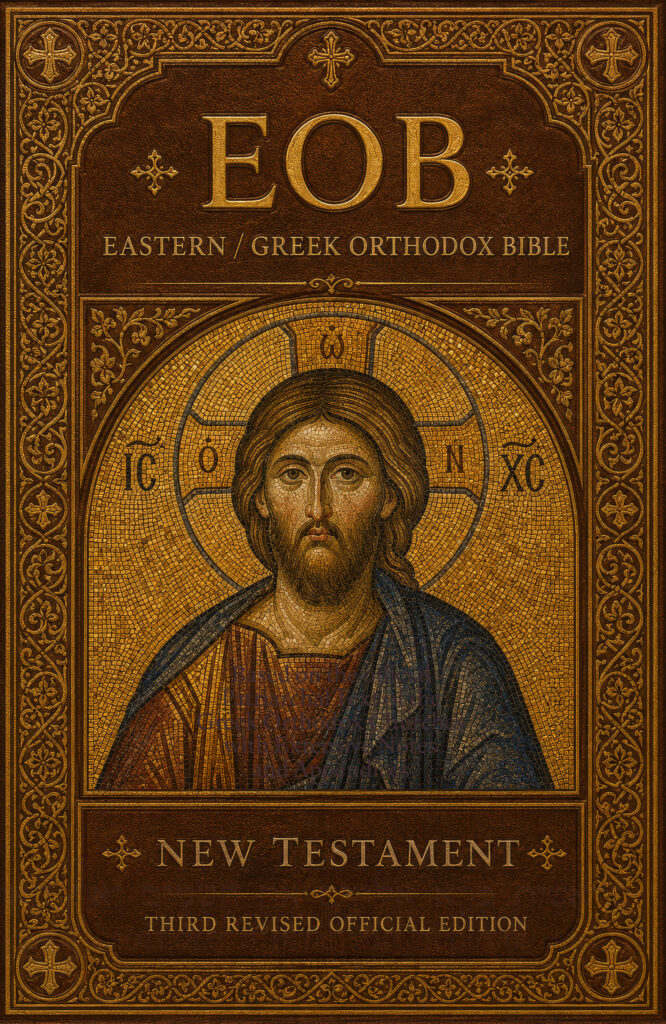
By: Fr Laurent Cleenewerck, EOB Editor The question is sometimes asked in what sense the EOB New Testament (the Eastern / Greek Orthodox Bible) is properly an Orthodox edition and
I. Title and place in the canon The English title comes from the Greek Leuitikon, “the Levitical book,” the book concerning the service of the priests and Levites. The Hebrew

I. Title and place in the canon The English title comes from the Greek Exodos, “going out” or “departure.” The Septuagint uses the word in 19:1, which dates the arrival